



Black Bird With a Yellow Beak: How to Identify 10 Common Species
If you saw a black bird with a yellow beak in the US, the most likely answer is a European Starling in breeding season. In California, a Yellow-billed Magpie is another strong possibility.
This guide helps you identify the most likely species for US readers, with a quick comparison table, regional clues, and simple ways to tell similar birds apart.

Comparison Table of Black Birds with Yellow Beaks
Use this table for a rapid side-by-side overview before reading the full profiles.
| Species | How well it fits this search | Key clue | Most likely where |
|---|---|---|---|
|
European Starling (Sturnus vulgaris) |
Best overall match for most US readers | Small, glossy dark body; bright yellow bill in breeding season | Cities, suburbs, lawns, farms across the US |
|
Yellow-billed Magpie (Pica nuttalli) |
Strong regional match | Much larger bird with a very long tail and bright yellow bill | California only |
|
Yellow-billed Cuckoo (Coccyzus americanus) |
Partial match / often confused | Yellow lower mandible, long tail, but not truly black | Woodlands, thickets, riparian habitat |
|
Eurasian Blackbird (Turdus merula) |
Common in global results, not typical in the US | True black thrush with orange-yellow bill | Mostly Europe, Asia, North Africa |
| Common Myna / Hill Myna | Useful for global comparison only | Yellow bill, darker body, more relevant outside the US | Asia and other introduced regions |
Common Blackbird (Eurasian Blackbird, Turdus merula)
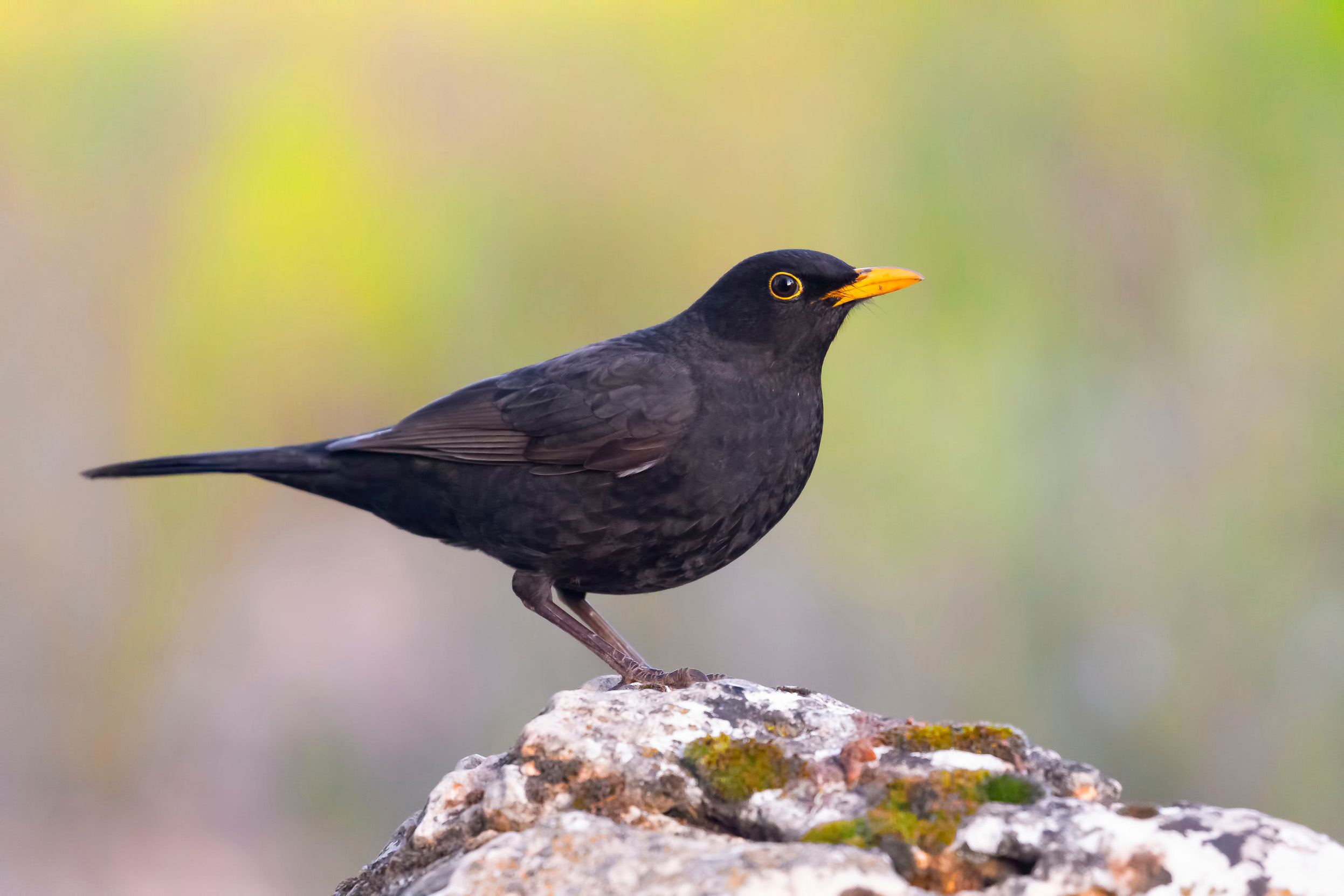
Habitat: Woodlands, gardens, and urban parks across Europe, Asia, and North Africa. Occasionally found in introduced populations.
Appearance: Males are glossy black with a bright orange-yellow bill and yellow eye-ring. Females are brownish with a duller bill.
Key Characteristics:
- Beak Type: Straight, medium length, ideal for probing soil.
- Feather Type: Soft, smooth, and silky
- Weight: 85-100 grams
- Size: 23 to 29 centimeters long
- Wing Span: 34–38 cm
- Lifespan: Average 2–5 years on average in the wild (up to 20+ years recorded).
Feeding Habits: Omnivorous — earthworms, insects, fruits, and berries. They forage on the ground, often flipping leaves.
Mating Habits: Males deliver beautiful, fluty songs from high perches to attract mates. Females build neat cup-shaped nests in shrubs or trees.
Fun Facts: Their song is so melodic that it has inspired classical music.
How to tell from Starling: Longer tail, no winter speckles, more upright thrush-like posture.
Yellow-billed Magpie (Pica nuttalli)
California's only endemic magpie and one of the most visually dramatic birds in North America: a long-tailed corvid with a bold black-and-white pattern, iridescent blue-green wing sheen, and a distinctive bright yellow bill.
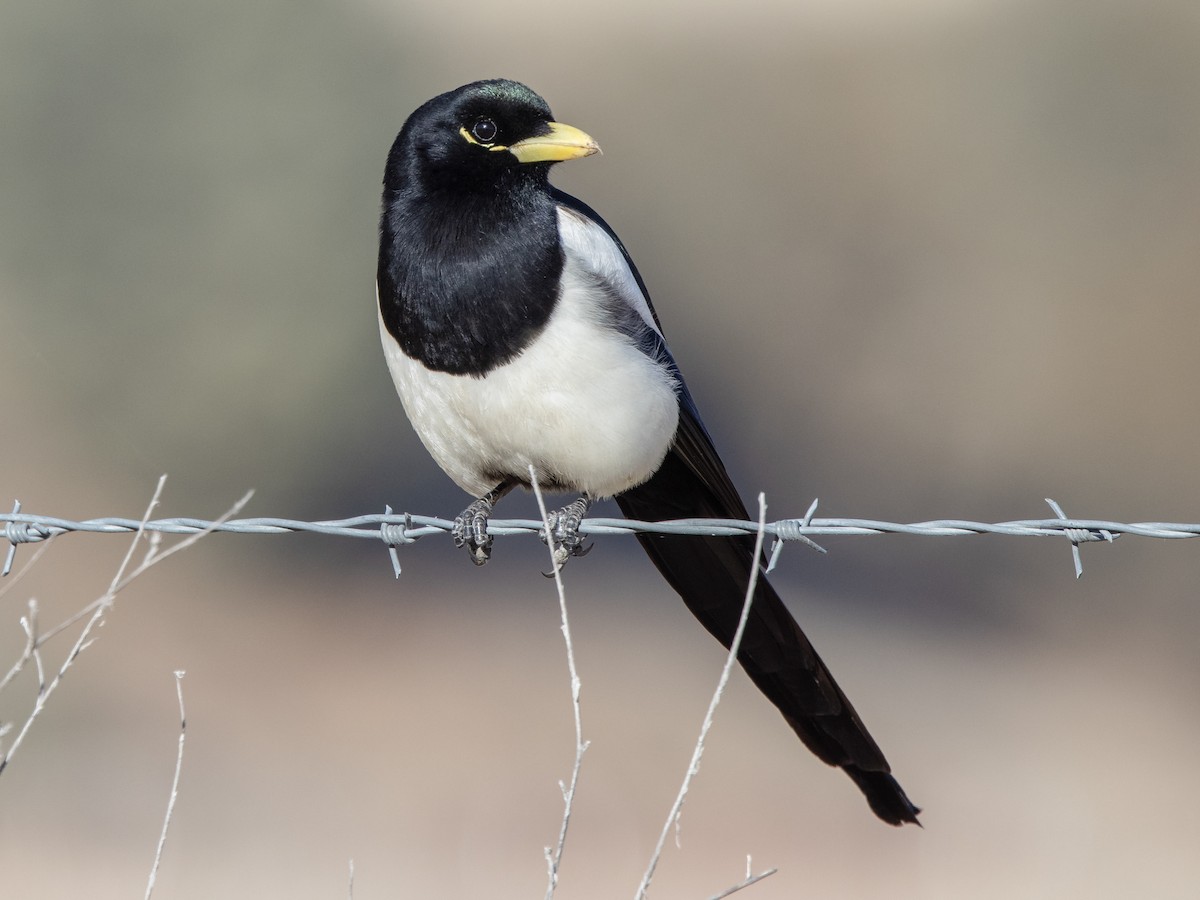
Habitat: Oak savannas, grassy areas, and scattered trees in California’s Central Valley and foothills.
Key Characteristics:
- Beak Type: Thick and slightly curved, versatile for a varied diet.
- Feather Type: They are glossy and stiff
- Weight: 120-150 grams
- Size: 40–50 cm in length
- Wing Length: 55–60 cm
- Lifespan: 5–10+ years.
Feeding Habits: Omnivorous, seeds, insects, carrion, small mammals, and fruits. Highly social foragers.
Mating Habits: Monogamous pairs build large, domed nests high in trees.
Fun Facts: Extremely intelligent and playful, like other corvids. They are California’s only endemic magpie.
Note: This species is listed as Vulnerable due to habitat loss and West Nile virus impacts. Protecting oak woodlands helps their survival.
Excellent spots for these black bird with yellow beak include Coyote Valley (South San Jose/Morgan Hill), East Bay oak groves, and agricultural edges. Look for their noisy groups in spring and summer.
European Starling (Sturnus vulgaris)
Introduced to North America in the 1890s, the European Starling is now one of the continent's most abundant birds. In breeding plumage, it is a glossy black bird with purple-green iridescence and a sharp yellow bill — but it looks very different in winter.

Habitat: Highly adaptable; open fields, urban areas, farms. Native to Europe/Asia, introduced worldwide, including North America.
Key Characteristics:
- Beak Type: Long, pointed, good for probing soil.
- Feather Type: Shiny with metallic texture
- Weight: 60–100 grams
- Size: 20–23 cm long
- Wing Length: 37–42 cm
- Lifespan: Up to 5 years.
Feeding Habits: Omnivorous — insects, seeds, fruits. Often forage in large flocks.
Mating Habits: Polygamous; males sing varied songs and build nests in cavities to attract multiple females.
Fun Facts: Masters of mimicry. The yellow beak black bird can imitate other birds and even human voices. Massive synchronized murmurations are spectacular.
Identification Tips: Distinguish from Blackbird: Shorter tail, speckled winter plumage, more aggressive urban behavior.
Yellow-billed Cuckoo (Coccyzus americanus)
Unlike the species above, the Yellow-billed Cuckoo is not truly 'black' — its upperparts are dark brownish-grey. However, its long tail with bold white spots underneath and its distinctive curved bill (yellow on the lower mandible) frequently generate black bird with yellow beak searches.
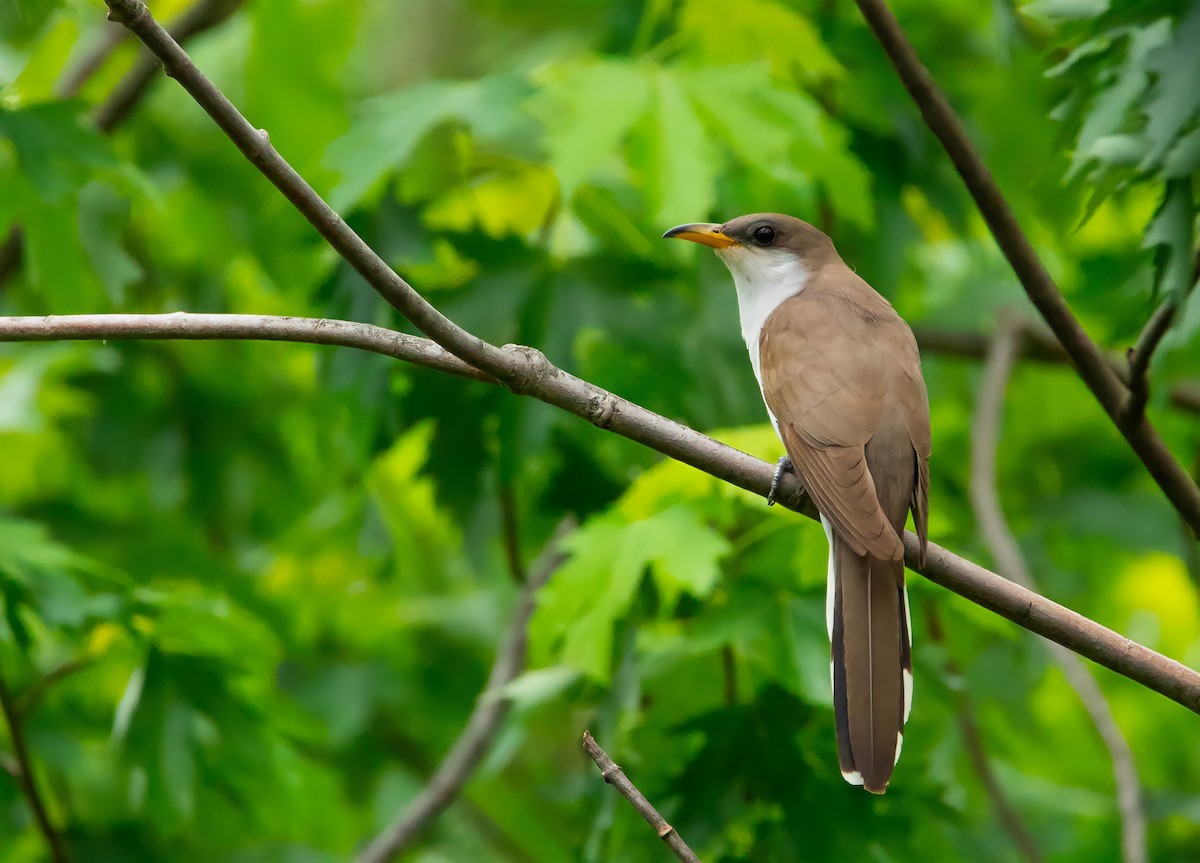
Habitat: Riparian woodlands, dense scrub, and forest edges across North America; winters in South America.
Key Characteristics:
- Beak Type: Hollowed, slender, and curved
- Feather Type: Long and soft, thick
- Weight: 60–90g
- Size: 26–30cm long
- Wing Length: 38–43cm
- Life Span: 5–6 years
Feeding Habits: They are insect eaters and consume caterpillars, beetles, and small fruits.
Mating Habits: Brood parasitic in some cases (lay eggs in other birds’ nests).
Fun Facts: Nicknamed “rain crow”, because this blackbird with yellow beak call is said to predict rain.
Hill Myna (Gracula religiosa)
The Hill Myna is arguably the most accomplished vocal mimic among birds, capable of reproducing human speech with uncanny precision. It is a striking bird with glossy jet-black plumage, a thick orange-yellow bill, and distinctive fleshy yellow wattles behind the eye.
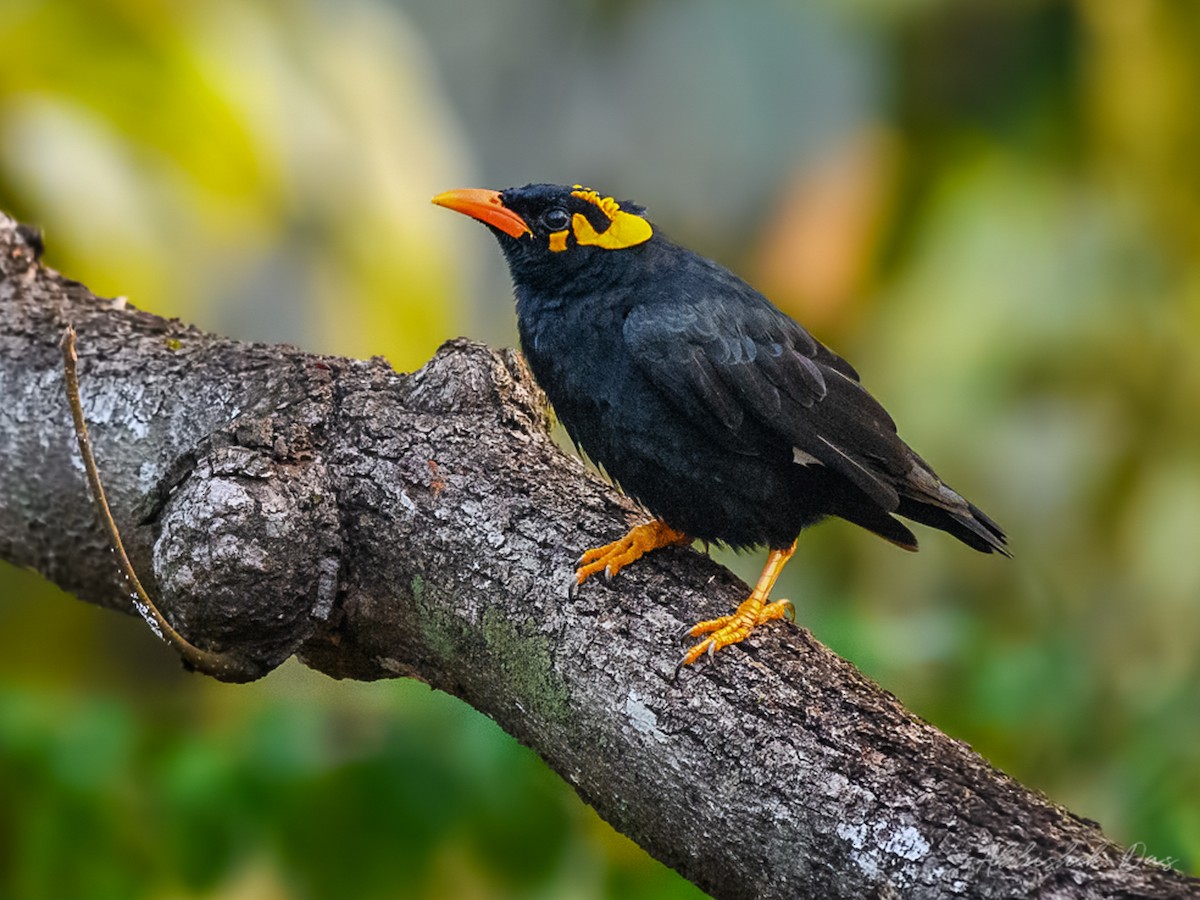
Habitat: Humid forests, forest edges, and farmlands across South and Southeast Asia (India, Sri Lanka, Thailand, Indonesia, and surrounding areas).
Key Characteristics:
- Beak Type: Thick and curved.
- Feather Type: Shiny and fleshy
- Weight: 200–300 grams
- Size: 25–30 cm long
- Wing Span: 36–40 cm
- Lifespan: 12–25 years (long-lived for a passerine).
Feeding Habits: Frugivorous, eats fruits and nectars and insects.
Mating Habits: Monogamous. Nest in tree cavities.
Fun Facts: Exceptional vocal mimics, often kept as pets for their ability to copy human speech clearly.
How to tell from Common Myna: Larger overall, fully glossy black (no brown tones), heavier bill, yellow wattles rather than a flat eye patch, and a superior vocal range.
Yellow-billed Chough (Alpine Chough, Pyrrhocorax graculus)
Also called the Alpine Chough, this corvid is one of the highest-altitude birds in the world, regularly recorded above 8,000 m on Everest. Its slender, bright yellow bill and vivid red legs make it unmistakable among mountain species.
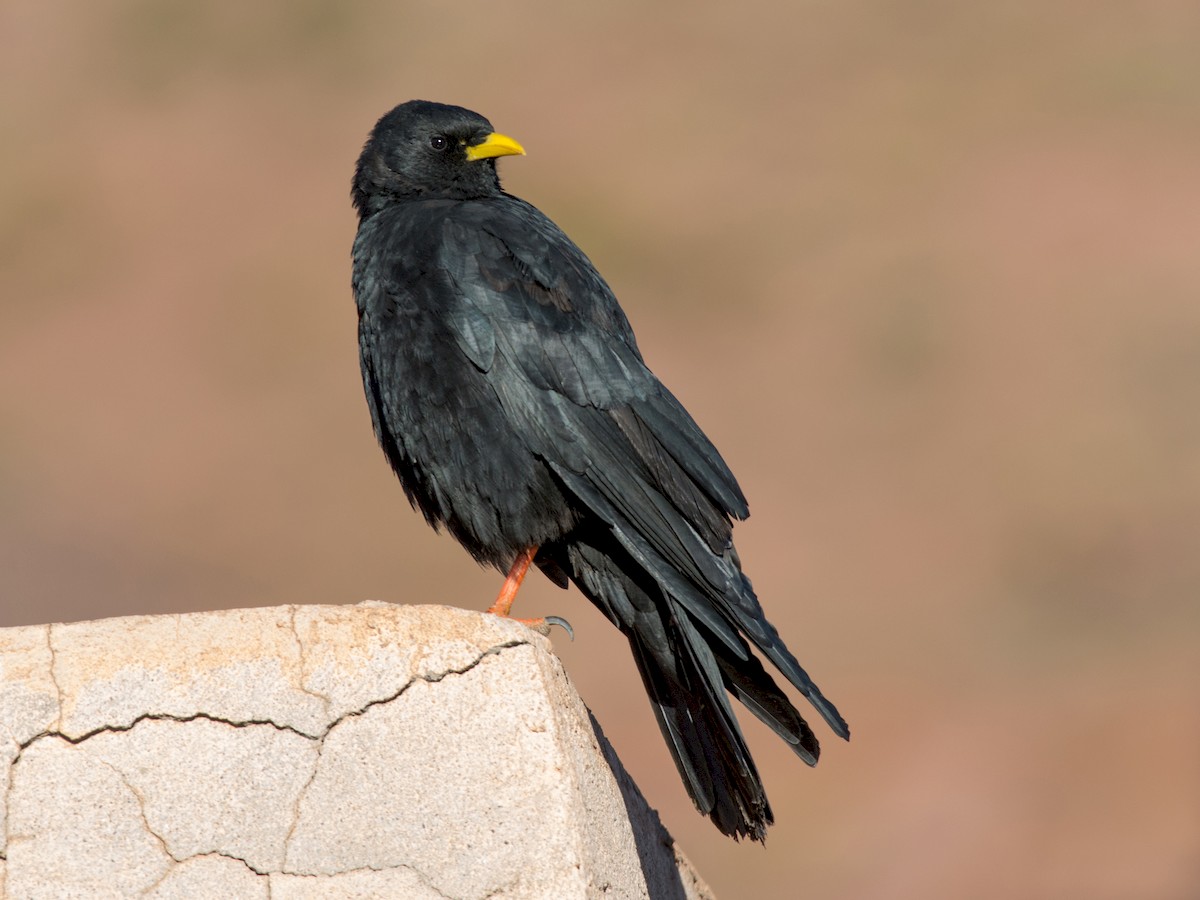
Habitat: High mountain cliffs, alpine meadows, and ski resorts in the Pyrenees, Alps, Caucasus, Himalayas, and Atlas Mountains.
Key Characteristics:
- Beak Type: thin and slightly curved, to scour best
- Feather Type: They are soft and shiny
- Weight: 180–250 grams
- Size: 37- 39 cm in length
- Wing Length: 65 to 75 cm
- Lifespan: 10–20 years.
Feeding Habits: Insects, seeds, berries, and human scraps.
Mating Habits: Monogamous lifelong pairs with impressive aerial courtship displays.
Fun Facts: Acrobatic flyers performing loops and dives. Highly sociable.
This is the same species known by both names (an Old World bird with no natural distribution in North America). It is most easily confused with the Red-billed Chough, which has a longer, curved red bill.
Common Myna (Acridotheres tristis)
One of the most successful bird colonizers on Earth, the Common Myna is now established on every inhabited continent. It is classified among the world's most invasive species, yet remains a charismatic and familiar urban bird across Asia.

Habitat: Cities, towns, farmland, roadsides, and open woodland. Native to South and Central Asia; introduced across Australasia, Africa, and the Americas.
Key Characteristics:
- Beak Type: Pointed and sturdy.
- Feather Type: Smooth and semi-glossy
- Weight: 100-150 grams. Size: 23–26 cm
- Wing Length: 40–50 cm
- Life Span: 12–15 years
Feeding Habits: Fruits, grains, insects.
Mating Habits: They make pair bonds and build nests in tree holes or human-made buildings.
Fun Facts: Excellent mimics of human voices and sounds.
Black Crake (Zapornia flavirostra)
A compact wetland bird from sub-Saharan Africa that is often overlooked due to its secretive habits but is surprisingly bold near the water's edge. The combination of slate-black plumage, bright yellow bill, vivid red eyes, and pink-red legs makes it one of the most colorfully accessorized birds on this list.

Habitat: Freshwater marshes, reedbeds, papyrus swamps, and lake margins across sub-Saharan Africa.
Key measurements: 19–23 cm long; 40–80 g; lifespan not well documented.
Feeding: Insects, small fish, frogs, invertebrates, and aquatic plant matter. Forages actively along muddy edges, often within a meter of open water.
Mating: Monogamous. Builds a cup nest of reeds above the water level. Both parents incubate.
Black Thrush (Turdus infuscatus)
A close relative of the Eurasian Blackbird, the Black Thrush occupies highland forests in Mexico and Central America, replacing the Eurasian species ecologically at higher elevations in the New World.

Habitat: Humid evergreen and pine-oak forests at elevations of 900–3,100 m in Mexico, Guatemala, Belize, and Honduras.
Key measurements: 25–27 cm long; 70–90 g.
Appearance: Adult male is entirely black with a bright yellow bill, yellow eye-ring, and yellow legs. The female is olive-brown. Very similar to Eurasian Blackbird, but the range is entirely separate.
Feeding: Primarily fruits, supplemented with insects. Often joins mixed-species flocks in the forest canopy.
Chinese Blackbird (Turdus mandarinus)
Formerly treated as a subspecies of the Eurasian Blackbird, the Chinese Blackbird is now recognized as a distinct species. It behaves very similarly to its European counterpart and occupies the same ecological niche across East Asia.

Habitat: Open forests, gardens, farms, and urban parks in China and parts of Indochina.
Key measurements: 26–29 cm long; 80–115 g.
Appearance: Males are sooty-black with an orange-yellow bill. Females are dark brown. Distinguished from the Eurasian Blackbird mainly by range and minor plumage differences detectable at close range.
Feeding: Earthworms, invertebrates, fruit, and berries. Frequently seen foraging on lawns and fields.
The Most Likely Species by Region
Your location is one of the strongest clues when identifying a black bird with a yellow beak.
North America
True all-black birds with yellow beaks are uncommon in North America. The most likely sightings are: European Starlings (coast to coast), Yellow-billed Magpie (California's Central Valley only), and Yellow-billed Cuckoo (Eastern/Central US, summer only). The bird called 'Blackbird' in North America refers to unrelated icterid species (Red-winged Blackbird, Brewer's Blackbird, etc.), which do not typically have yellow beaks.
UK and Western Europe
By far the most probable candidate is the adult male Eurasian Blackbird. It is among the UK's 10 most common birds and is found in virtually every garden, park, and woodland. European Starlings are also common but have a shorter tail and speckled winter plumage. Any other species would be considered unusual or exotic.
Eastern Europe and Central Asia
The Eurasian Blackbird remains the dominant candidate. At higher elevations, the Yellow-billed Chough becomes possible. The Chinese Blackbird takes over in the far east.
South and Southeast Asia
The Common Myna is the overwhelming frontrunner in cities, farms, and disturbed habitats. The Hill Myna is the likely candidate in forested or rural highland areas. Both are vocal, social, and highly visible.
Sub-Saharan Africa
The Black Crake is the best fit in wetland and marsh habitats. In open woodland and gardens, introduced Common Mynas are increasingly present in East and Southern Africa.
Australasia and Pacific Islands
Common Mynas are now abundant in Australia, New Zealand, and many Pacific islands as introduced invasives. Hill Mynas are locally present in some areas.
Birdwatching Tip
If you enjoy identifying backyard birds by details like bill color, posture, and behavior, a smart bird feeder camera can make the process much easier. It gives you a second look at fast visits and helps you compare similar species more carefully later.
For birds that only pause for a few seconds, that extra view can make the difference between a guess and a confident ID.

Birdfy Feeder 1
Experience crystal-clear 2K resolution. Every detail brought right before your eyes.
Buy NowTurn your backyard into your personal bird photography studio with Birdfy.
15% OFF
Storewide Exclusives
Enter the code at checkout to enjoy the discount.
How to Attract Black Bird With Yellow Beak to Your Garden
In the US, the bird from this list you are most likely to attract is the European Starling, although most backyard bird lovers are really aiming to support a wider range of visiting species rather than starlings alone.
Here are a few practical ways to make your yard more attractive to yellow-billed and other visiting birds:
- Add a shallow birdbath: : Clean, fresh water is one of the best all-purpose attractants for backyard birds.
- Offer soft foods: Mealworms, suet, and fruit can attract birds that are less interested in seed-heavy feeders.
- Keep some open ground space: Many birds prefer to forage on lawns, patios, or open soil rather than only at hanging feeders.
- Plant native shrubs and trees: These provide shelter, nesting cover, and natural food sources like berries and insects.
- Reduce heavy pesticide use: A healthier yard supports more insects, which in turn supports more birds.
FAQs about Black Bird with Yellow Beak
Are any of these species protected?
The Yellow-billed Magpie is listed as Vulnerable and all wild birds in the US are protected under the Migratory Bird Treaty Act. It is illegal to disturb nesting birds of any species. The Common Myna and European Starling are classified as invasive species in several countries, and local control programs exist in some regions.
Is a blackbird with a yellow beak always a male?
In the Eurasian Blackbird, yes. A vivid orange-yellow bill and eye-ring indicate an adult male. Females have a brown bill, sometimes with a pale yellowish tinge. However, in myna species (Hill Myna, Common Myna) both sexes have the same yellow beak, so sex cannot be determined from bill color alone.
Do female blackbirds have yellow beaks?
Female Eurasian Blackbirds have a duller, olive-brown or pale yellowish-brown bill — not the vivid orange-yellow of the male. Young females can have a particularly dark bill. By contrast, female Hill Mynas and Common Mynas share the same bright yellow bill as the male.
Why does the beak look yellow in some seasons but not others?
In the Eurasian Blackbird, bill color is driven by hormones linked to breeding condition. The bill is brightest orange-yellow in spring, dulling toward brown-yellow after the breeding season. European Starlings follow a similar pattern.
What bird looks black with a yellow beak in my garden?
In a UK or European garden, this is almost certainly a male Eurasian Blackbird. In North America, a European Starling in breeding plumage is the most likely answer. In South or Southeast Asian cities, the Common Myna is the overwhelmingly probable candidate. Check the regional breakdown section above for more detail.
Can I use a bird feeder to attract black birds with yellow beaks?
Eurasian Blackbirds prefer ground-feeding rather than a hanging feeder. European Starlings will use most feeder types. A clean, shallow birdbath is effective for attracting both species. For mynas in Asia and Australasia, soft fruit placed on a platform works well.
Conclusion
Black birds with yellow beaks are found on every inhabited continent, from the melodic Eurasian Blackbird in a British garden to the acrobatic Yellow-billed Chough on an Alpine cliff face. Knowing how to read the key field marks — beak color intensity, eye-ring presence, tail length, leg color, and regional range — transforms an uncertain sighting into a confident identification.
The next time you spot one, work through the quick ID checklist at the top of this guide. And if you want to build a photographic record of every visitor to your yard, a smart bird feeder makes that process effortless.
Happy birding, and share your sightings in the comments below.
1 comment
A small blackbird with yellow beak n red eyes a Brewers blackbird


