



Black Bird with Yellow Beak: Complete US Identification Guide
If you saw a black bird with a yellow beak in the US, the answer usually comes down to just a few likely species. In most cases, it is a European Starling in breeding plumage. In parts of California, a Yellow-billed Magpie is another strong possibility. A Yellow-billed Cuckoo can also cause confusion, although it is not truly black.
The fastest way to identify the bird is to check size, region, season, and tail shape. This guide covers the most likely US species, how to tell them apart, and which lookalikes to rule out.

Quick Answer
In most of the US, the most likely bird is a European Starling in breeding plumage. In California’s Central Valley and nearby foothills, a Yellow-billed Magpie is another strong possibility.
Quick Comparison: Black Birds with Yellow Beaks in the US
Use this table for a rapid side-by-side overview before reading the full profiles.
| Species | Best Match For | Where in US | Top ID Clue |
|---|---|---|---|
|
European Starling (Sturnus vulgaris) |
Most US readers | Coast to coast | Glossy black, yellow bill in spring; speckled in winter |
|
Yellow-billed Magpie (Pica nuttalli) |
California readers | Central Valley + foothills only | Very long tail, bold black-and-white, bright yellow bill |
|
Yellow-billed Cuckoo (Coccyzus americanus) |
Eastern/Central US, summer | Riparian woodlands, East + Midwest | Long spotted tail, yellow lower mandible; not truly black |
|
Common Myna (Acridotheres tristis) |
Global comparison | Florida, Hawaii (introduced) | Brown body, white wing patch, yellow bill and eye patch |
European Starling (Sturnus vulgaris)
The European Starling is by far the most likely answer for most US readers. It is common across cities, suburbs, farmland, schoolyards, lawns, and open country throughout the continental United States.
In spring and early summer, adult Starlings often look glossy black at a distance, with purple-green iridescence and a bright yellow bill. In fall and winter, the same birds look very different: the bill turns dark and the plumage becomes heavily speckled with pale spots.
This seasonal change is one reason people often do not realize they are seeing the same species.

| Characteristic | Size | Weight | Wingspan | Key ID Feature |
|---|---|---|---|---|
| Body length | 20–23 cm | 60–100 g | 37–42 cm | Short tail, upright posture when foraging |
| Bill | Long, pointed, probing | — | — | Bright yellow (spring); dark (autumn/winter) |
| Plumage | Glossy black + iridescence | — | — | White speckles in autumn/winter only |
| Voice | Complex mimicry | — | — | Can copy other birds, car alarms, human speech |
Starlings often feed on open ground, probing for insects and grubs. They usually look stocky, short-tailed, and upright, especially when walking across a lawn or gathering around feeders.
How to tell from other species: A Starling is:
- smaller and shorter-tailed than a crow
- more compact than a grackle
- more likely to show a yellow bill only in spring and summer
- commonly found in urban and suburban areas
If the bird was small to medium-sized, dark overall, and seen on a lawn or at a feeder, European Starling is the safest first choice.
Yellow-billed Magpie (California Only)
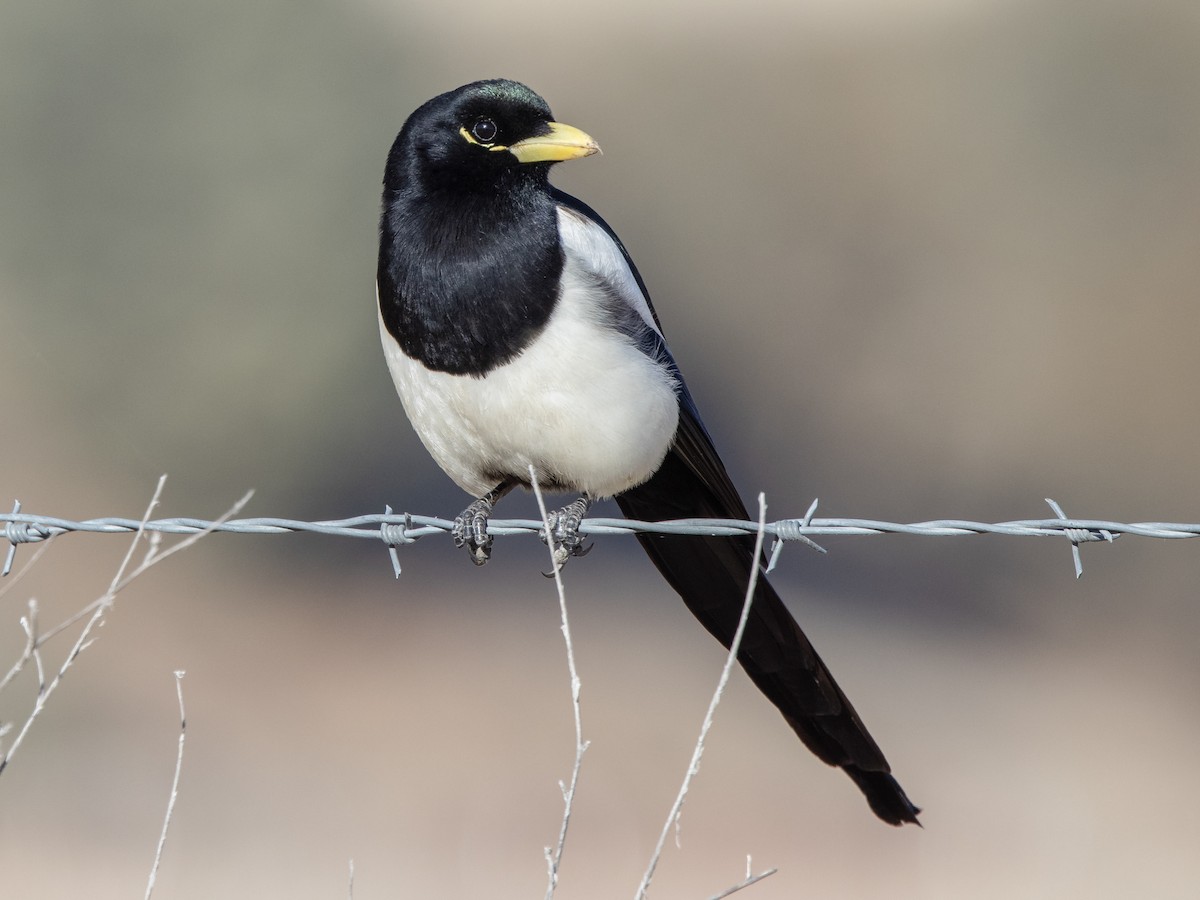
If you are in California and the bird was large, black-and-white, and extremely long-tailed, you may be looking at a Yellow-billed Magpie.
This species is found only in California, mainly in the Central Valley and nearby foothills. It is a striking corvid with a bright yellow bill, yellow skin around the eye, glossy black plumage, white patches on the body, and a long iridescent tail.
| Characteristic | Size | Weight | Wingspan | Key ID Feature |
|---|---|---|---|---|
| Body length | 40–50 cm | 120–150 g | 55–60 cm | Very long tail (up to 30 cm); longer than body |
| Bill | Thick, slightly curved | — | — | Vivid yellow, year-round (both sexes) |
| Plumage | Black + white; blue-green gloss on wings/tail | — | — | Bold white shoulder and belly patches |
| Social | Highly social; loose colonies | — | — | Often seen in noisy groups of 6–20+ |
The tail length is often the fastest clue. A Yellow-billed Magpie looks much longer and looser in shape than a Starling, with a tail that can appear nearly body-length or longer.
Conservation Note: The Yellow-billed Magpie is a California endemic and has declined because of habitat loss and West Nile virus. It remains one of the most distinctive regional birds in the state.
How to tell from Black-billed Magpie: The Black-billed Magpie, found in parts of the Mountain West, has a black bill, not a yellow one. In most situations, bill color alone separates the two species quickly.
Yellow-billed Cuckoo (Coccyzus americanus)
The Yellow-billed Cuckoo is a less likely match than a Starling or Yellow-billed Magpie, but it can still cause confusion.
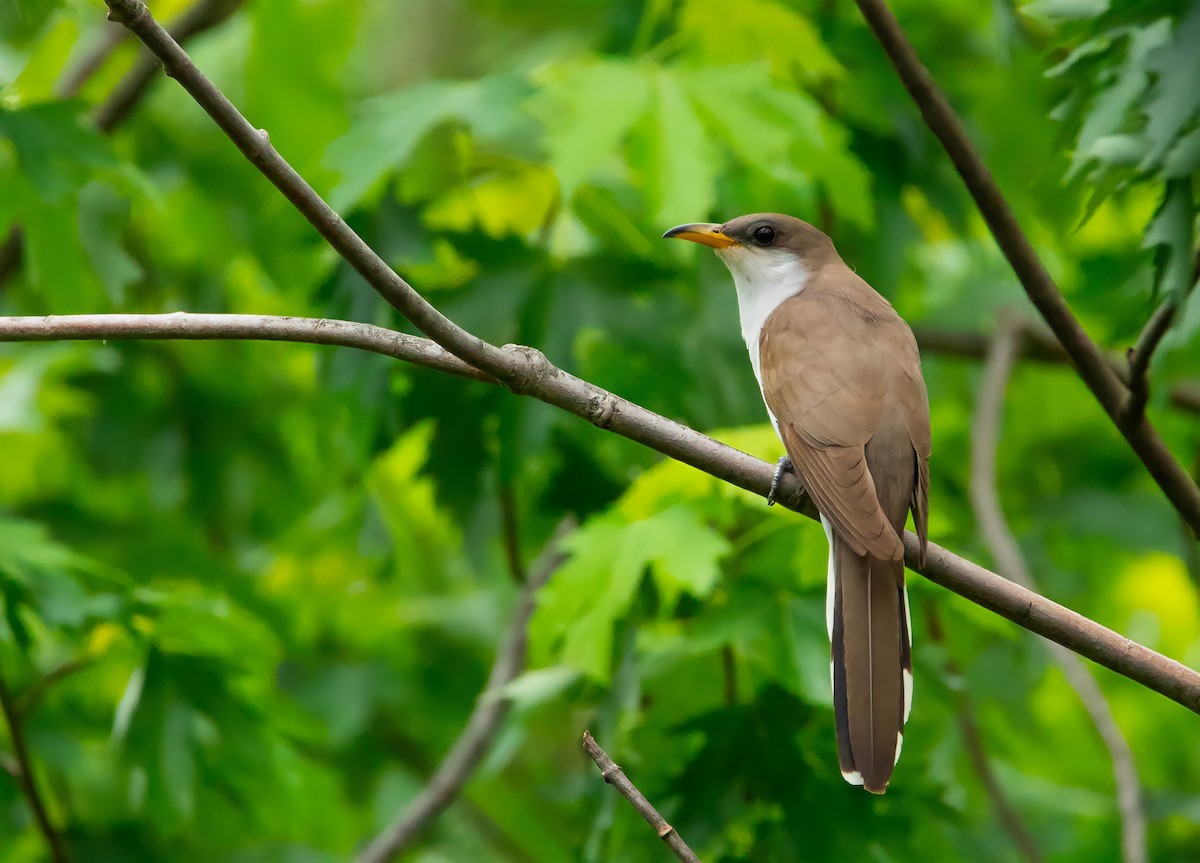
This bird is not truly black. Its upperparts are dark brownish-gray, and its underparts are white. In poor light, though, the dark back and yellowish lower bill can make it seem like a black bird with a yellow beak at first glance.
| Characteristic | Size | Weight | Wingspan | Key ID Feature |
|---|---|---|---|---|
| Body length | 26–30 cm | 60–90 g | 38–43 cm | Long tail with bold white spots below |
| Bill | Slender, curved | — | — | Yellow lower mandible; darker upper |
| Upperparts | Dark brownish-grey | — | — | Not true black — key difference from Starling |
| Range | E + Central US (summer) | — | — | Winters in South America; arrives May |
This species is most often found in dense riparian woodland, forest edges, and leafy thickets during the summer breeding season.
If your bird looked sleek, quiet, and long-tailed rather than stocky and glossy, this species is worth considering.
Identification by Size: Small vs Large Black Birds with Yellow Beaks
Size is often the first thing you notice before you can clearly see the bill color or tail shape. Use this section to narrow your identification when the overall impression of size is your strongest memory.
Small Black Birds with Yellow Beaks (Under 25 cm)
If the bird you saw was clearly small, roughly Robin-sized or smaller, the identification is almost certainly:
- European Starling (breeding): 20–23 cm, short stubby tail, foraging on lawns or clustered at feeders. The most abundant and most likely candidate.
- Yellow-billed Cuckoo: 26–30 cm at the larger end of this category — often appears more slender and elongated than its length suggests. Found in woodland, not lawns.
- House Sparrow (partial match): Some worn male plumage and bill can look yellowish — but this bird is distinctly smaller (14–16 cm) and brown, not black.
Field Note: The Starling’s Size Is Deceptive Starlings look larger than they are when they puff up in cold weather or when foraging with their wings slightly open. Compared to a nearby American Robin (25 cm), the Starling is noticeably shorter. Its upright walking posture also makes it look stockier than thrushes of similar length.
Large Black Birds with Yellow Beaks (Over 35 cm)
If the bird was clearly large — crow-sized or bigger, with an especially long tail:
- Yellow-billed Magpie: 40–50 cm, California only. The long tail (up to 30 cm), black-and-white body, and vivid yellow bill are unmistakable. Often seen in noisy groups.
- American Crow (non-match, for comparison): 45–53 cm and all-black, but the bill is heavy and black — no yellow. Worth ruling out before concluding Magpie.
- Common Raven (non-match, for comparison): 56–69 cm, much larger, with a massive curved black bill and wedge-shaped tail — no yellow bill component.
Regional Guide: Most Likely Species by US Location
Eastern US (East of the Mississippi)
The European Starling is overwhelmingly the dominant answer across the entire eastern US — in cities, suburbs, farmland, and open woodland alike. Its year-round abundance means it is present in every season.
The Yellow-billed Cuckoo is a summer visitor (May–September) in riparian woodlands and forest edges from Maine to Florida and westward through the Great Plains. Look for it in dense vegetation along rivers and streams.
Midwestern US
The European Starling remains the dominant species. Yellow-billed Cuckoos are regular summer visitors in the wooded corridors of the Ohio River Valley, Missouri River bottomlands, and the forested fringes of the Great Plains.
Western US (Excluding California)
The European Starling is common throughout the Pacific Northwest, Mountain West, and Desert Southwest. Yellow-billed Cuckoos occur in small, declining populations along riparian corridors in Arizona, New Mexico, and the Sacramento Valley.
The Yellow-billed Magpie does NOT naturally occur outside California; occasional sightings in southern Oregon have been documented, but are rare.
California
California is the only state where you must choose between two strong candidates: the European Starling (coast to coast, ubiquitous) and the Yellow-billed Magpie (Central Valley and foothills).
Size and tail length resolve the ID immediately: a short-tailed, Robin-sized bird = Starling; a long-tailed, crow-sized bird = Magpie. Habitat also helps. Starlings prefer open lawns and urban areas, while Magpies favor oak savannas and agricultural edges.
Hawaii and Florida (Introduced Species)
The Common Myna (Acridotheres tristis) is established as an invasive species in Hawaii and parts of southern Florida. It has a brownish-black body, white wing patches visible in flight, and a bright yellow bill and eye patch.
Hill Mynas (the superior vocal mimic, all-glossy-black) are occasionally kept as pets and may escape, but wild populations in the US are not established.
Global Reference: Other Black Birds with Yellow Beaks/h2>
If you are outside the US, or if you want to understand why UK, European, and Asian results appear in your searches, the following species are the relevant candidates. These are condensed profiles; the US-based species above receive full treatment.
Eurasian Blackbird (UK/Europe)
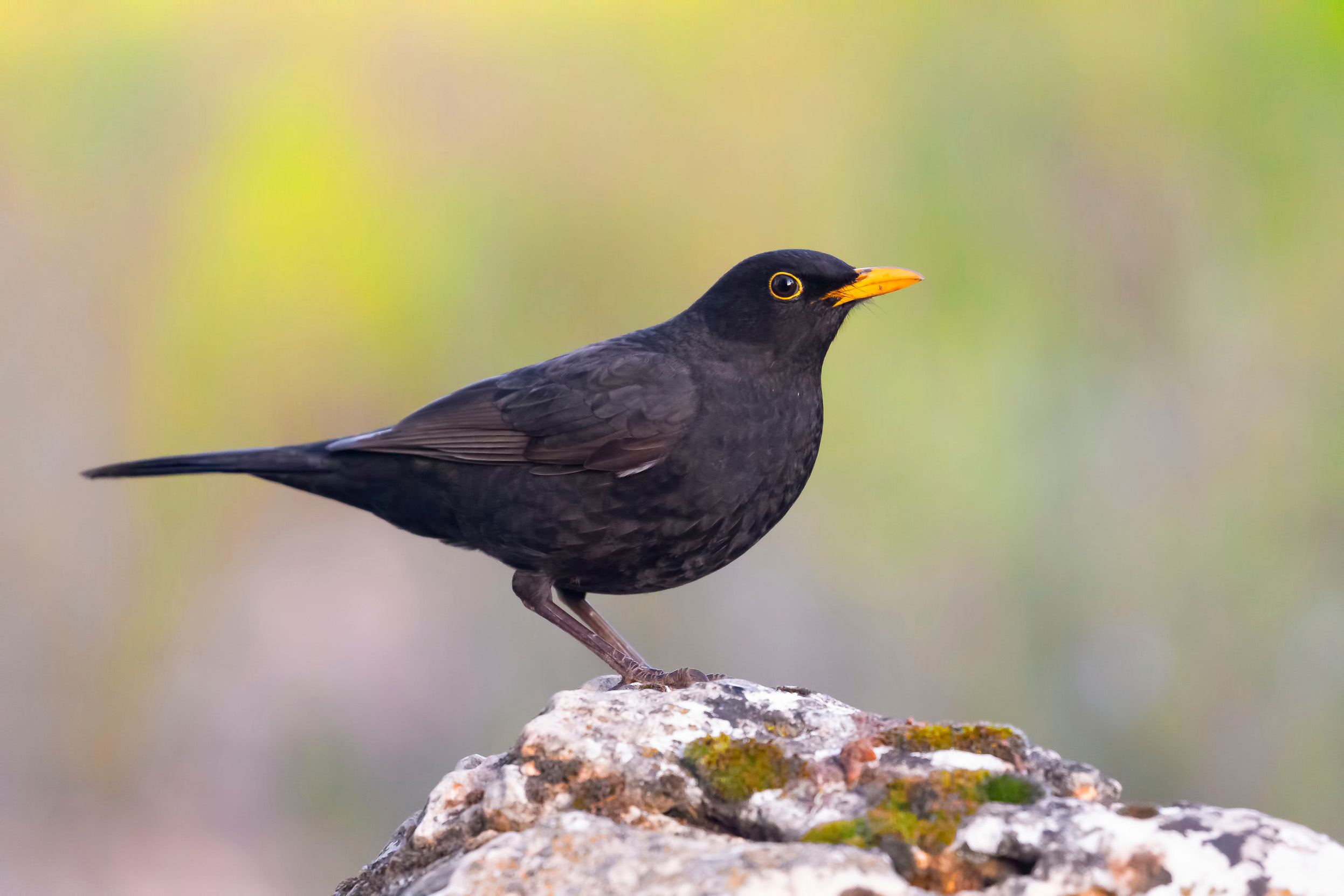
The UK’s most familiar garden bird. An adult male is true glossy black with a vivid orange-yellow bill and eye-ring. The female is brown. Found in gardens, parks, and woodlands across Europe, Asia, and North Africa. Inspirational songs have influenced classical composers.
Common Myna (South/Southeast Asia, introduced globally)

Brown-black body, white wing patch, yellow bill, and eye patch. Listed among the world’s most invasive species. Established in Australia, New Zealand, Hawaii, and Florida.
Hill Myna (South/Southeast Asia)
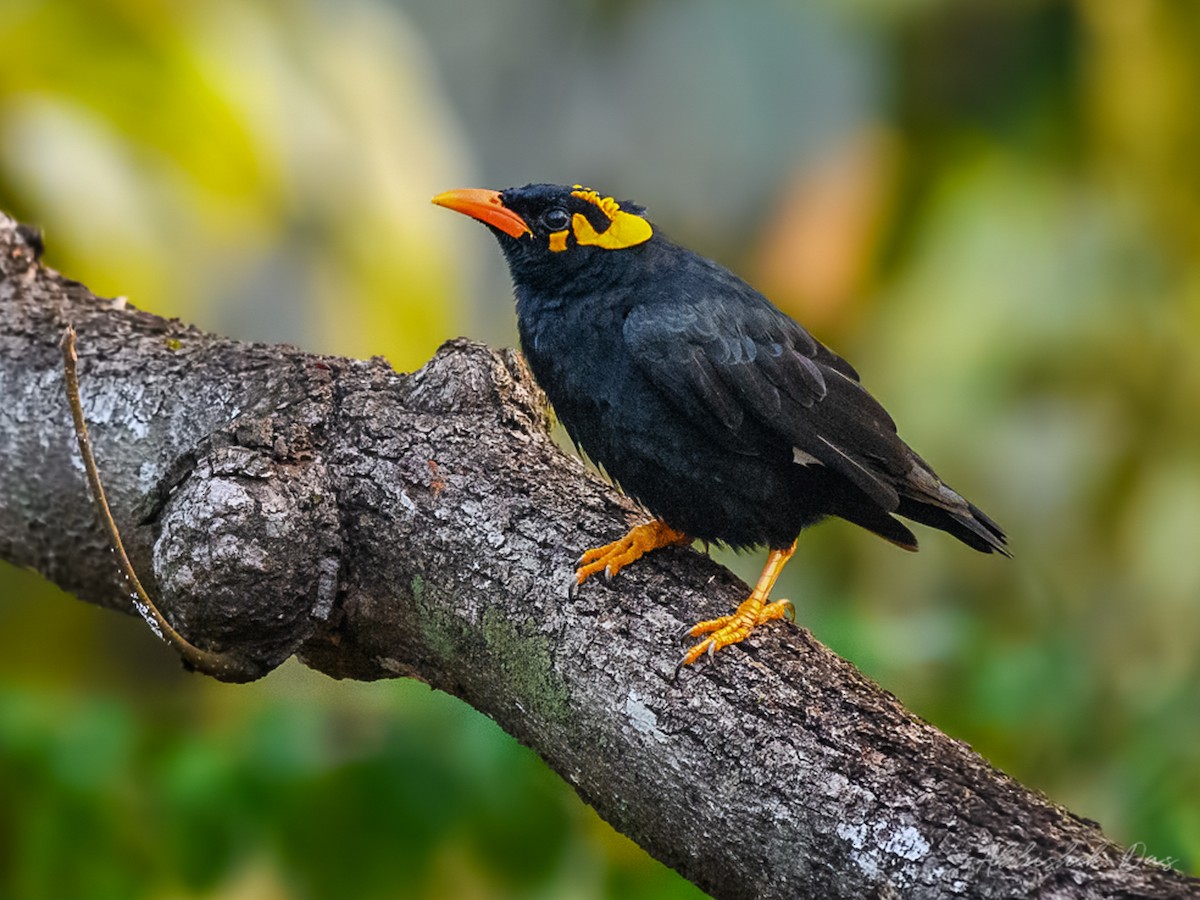
Fully glossy black, thick orange-yellow bill, yellow wattles. The superior vocal mimic can reproduce human speech with uncanny precision. Forest and forest-edge species.
Yellow-billed Chough / Alpine Chough (European mountains)
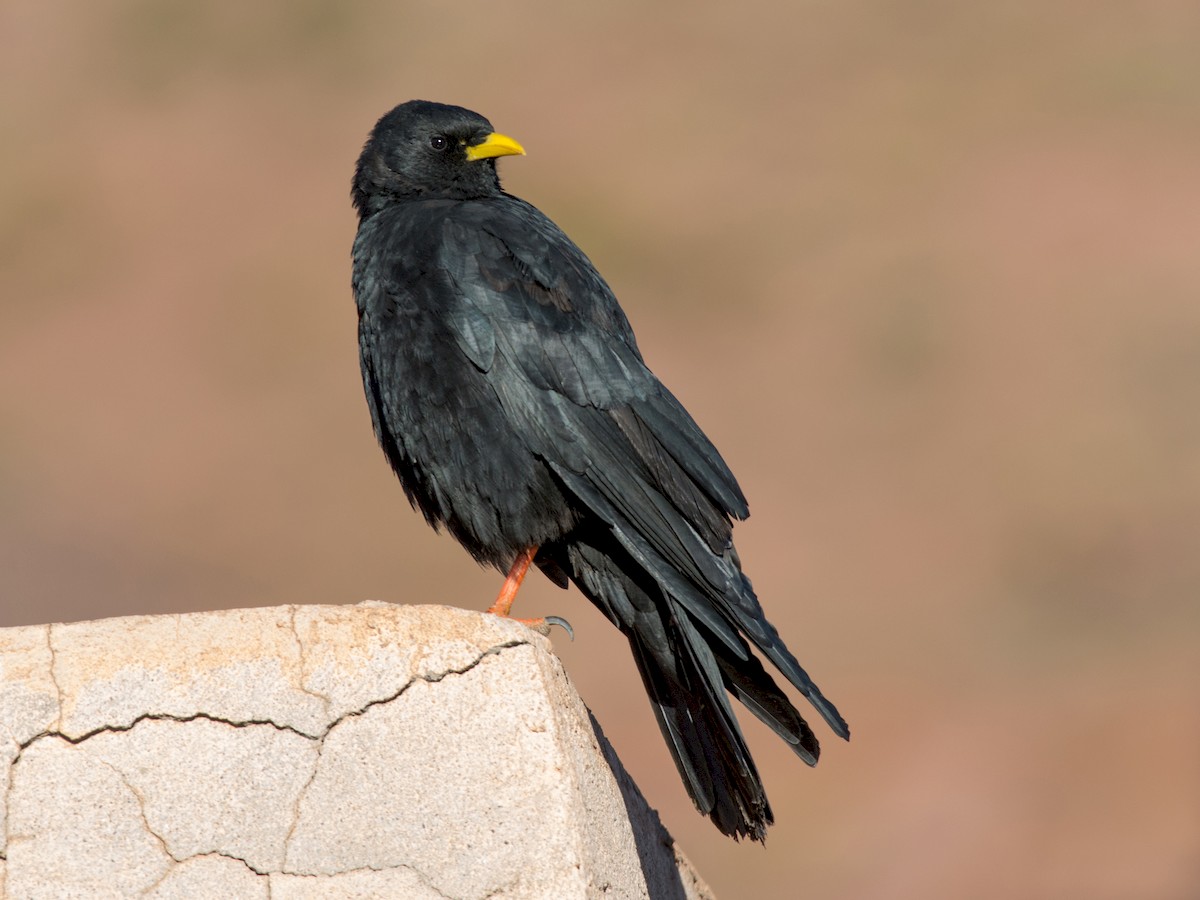
All-black corvid with a slender bright-yellow bill and vivid red legs. One of the highest-altitude birds on Earth was recorded above 8,000 m on Everest. Found in the Alps, Pyrenees, Caucasus, and Himalayas.
Black Crake (sub-Saharan Africa)

Compact wetland bird with slate-black plumage, bright yellow bill, red eyes, and pink-red legs. Freshwater marshes and reedbeds across sub-Saharan Africa.
Chinese Blackbird (East Asia)

Formerly treated as a subspecies of Eurasian Blackbird; now a distinct species. Sooty-black male with orange-yellow bill. Urban parks, gardens, and farmland in China and Indochina.
Birdwatching Tip
If you enjoy identifying backyard birds by details like bill color, posture, and behavior, a smart bird feeder camera can make the process much easier. It gives you a second look at fast visits and helps you compare similar species more carefully later.
For birds that only pause for a few seconds, that extra view can make the difference between a guess and a confident ID.

Birdfy Feeder 1
Experience crystal-clear 2K resolution. Every detail brought right before your eyes.
Buy NowTurn your backyard into your personal bird photography studio with Birdfy.
15% OFF
Storewide Exclusives
Enter the code at checkout to enjoy the discount.
FAQs about Black Bird with Yellow Beak
Are any of these species protected?
The Yellow-billed Magpie is listed as Vulnerable and all wild birds in the US are protected under the Migratory Bird Treaty Act. It is illegal to disturb nesting birds of any species. The Common Myna and European Starling are classified as invasive species in several countries, and local control programs exist in some regions.
Is a blackbird with a yellow beak always a male?
In the Eurasian Blackbird, yes. A vivid orange-yellow bill and eye-ring indicate an adult male. Females have a brown bill, sometimes with a pale yellowish tinge. However, in myna species (Hill Myna, Common Myna) both sexes have the same yellow beak, so sex cannot be determined from bill color alone.
Do female blackbirds have yellow beaks?
Female Eurasian Blackbirds have a duller, olive-brown or pale yellowish-brown bill — not the vivid orange-yellow of the male. Young females can have a particularly dark bill. By contrast, female Hill Mynas and Common Mynas share the same bright yellow bill as the male.
Why does the beak look yellow in some seasons but not others?
In the Eurasian Blackbird, bill color is driven by hormones linked to breeding condition. The bill is brightest orange-yellow in spring, dulling toward brown-yellow after the breeding season. European Starlings follow a similar pattern.
What bird looks black with a yellow beak in my garden?
In a UK or European garden, this is almost certainly a male Eurasian Blackbird. In North America, a European Starling in breeding plumage is the most likely answer. In South or Southeast Asian cities, the Common Myna is the overwhelmingly probable candidate. Check the regional breakdown section above for more detail.
Can I use a bird feeder to attract black birds with yellow beaks?
Eurasian Blackbirds prefer ground-feeding rather than a hanging feeder. European Starlings will use most feeder types. A clean, shallow birdbath is effective for attracting both species. For mynas in Asia and Australasia, soft fruit placed on a platform works well.
Conclusion
A black bird with a yellow beak in the US almost always resolves to one of three species: the European Starling, the Yellow-billed Magpie, or the Yellow-billed Cuckoo.
Run the 30-second checklist at the top of this guide — size, location, season, tail length, and habitat — and you will have a confident identification in under a minute.
The next time you spot one, work through the quick ID checklist. And if you want to build a photographic record of every visitor to your yard, a smart bird camera makes that process effortless — every visit logged, every species identified.
1 comment
A small blackbird with yellow beak n red eyes a Brewers blackbird


