













10 Black Birds with Yellow Beaks: Identification, Habitats & Facts
Black birds with yellow beaks stand out dramatically against their dark plumage, making them favorites among birdwatchers and nature photographers. Their vivid contrast not only create a striking visual but also aids quick field identification. These adaptable species thrive in diverse environments, from urban gardens to remote mountains.
In this guide, we'll explore 10 notable black birds with bright yellow beaks, including key identification tips, habitats, feeding and mating behaviors, and practical spotting advice.

Comparison Table of Black Birds with Yellow Beaks
| Species | Beak Features | Length(cm) | Weight(g) | Conservation |
|---|---|---|---|---|
| Common Blackbird(Turdus merula) | Orange-yellow, straight, medium length + yellow eye-ring | 23–29 | 80–125 | Stable |
| Yellow-billed Magpie(Pica nuttalli) | Bright yellow, thick, slightly curved | 40–54 | 120–190 | Vulnerable(habitat loss, West Nile virus) |
| European Starling(Sturnus vulgaris) | Long, pointed, bright yellow in breeding | 20–23 | 60–100 | Stable/invasive in some areas |
| Hill Myna(Gracula religiosa) | Thick, bright orange-yellow, curved | 25–30 | 200–300 | Not threatened |
| Yellow-billed Chough(Pyrrhocorax graculus & Alpine Chough) | Slender, straight, bright yellow | 34–39 | 160–277 | Stable |
| Common Myna(Acridotheres tristis) | Bright yellow, pointed, sturdy | 23–26 | 82–143 | Stable/invasive in some regions |
| Yellow-billed Cuckoo(Coccyzus americanus) | Slender, curved(lower mandible yellow) | 26–30 | 55–65 | Declining in some areas |
Common Blackbird (Eurasian Blackbird, Turdus merula)
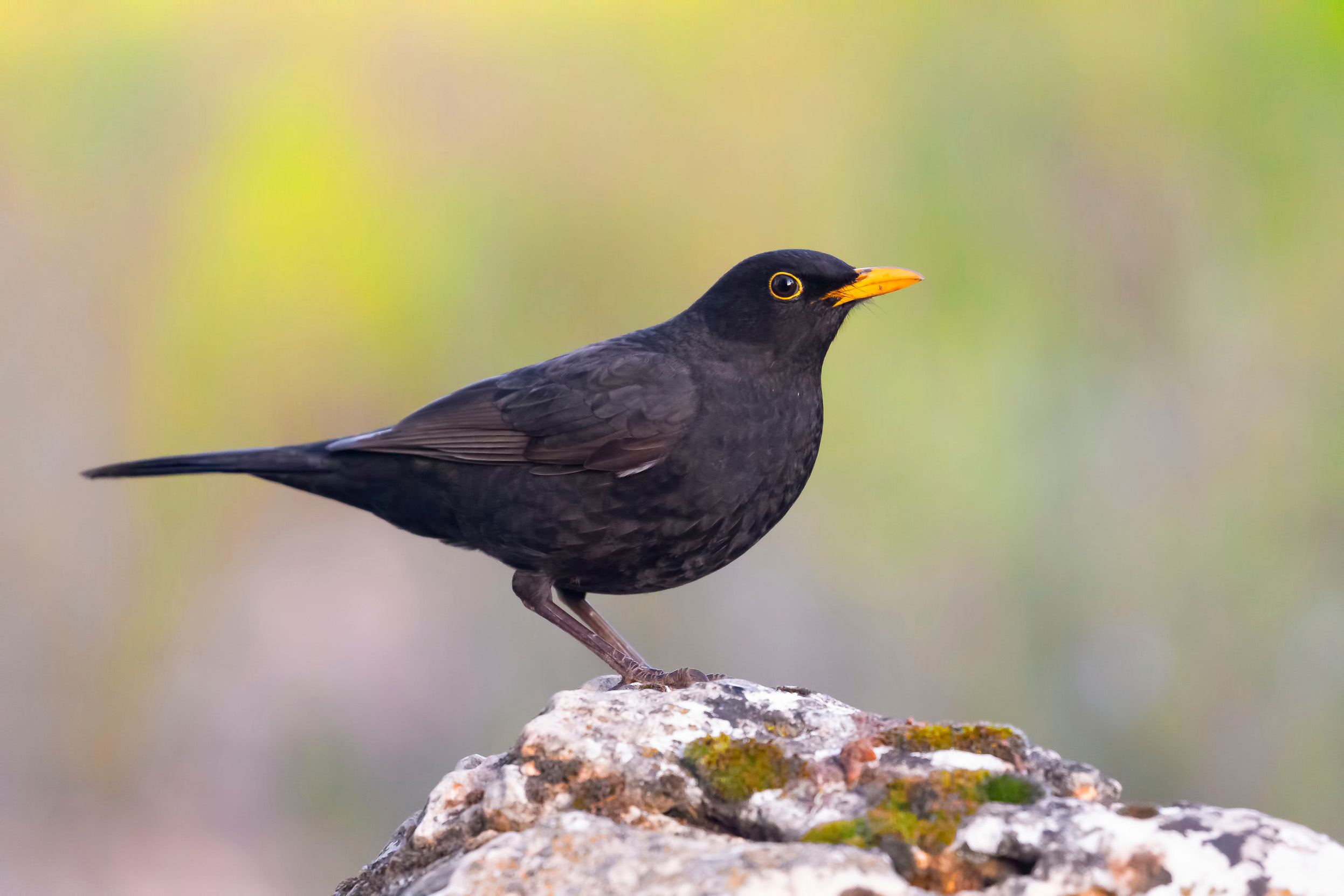
Habitat: Woodlands, gardens, and urban parks across Europe, Asia, and North Africa. Occasionally found in introduced populations.
Appearance: Males are glossy black with a bright orange-yellow bill and yellow eye-ring. Females are brownish with a duller bill.
Key Characteristics:
- Beak Type: Straight, medium length, ideal for probing soil.
- Feather Type: Soft, smooth, and silky
- Weight: 85-100 grams
- Size: 23 to 29 centimeters long
- Wing Span: 34–38 cm
- Lifespan: Average 2–5 years on average in the wild (up to 20+ years recorded).
Feeding Habits: Omnivorous — earthworms, insects, fruits, and berries. They forage on the ground, often flipping leaves.
Mating Habits: Males deliver beautiful, fluty songs from high perches to attract mates. Females build neat cup-shaped nests in shrubs or trees.
Fun Facts: Their song is so melodic that it has inspired classical music.
How to tell from Starling: Longer tail, no winter speckles, more upright thrush-like posture.
Yellow-billed Magpie (Pica nuttalli)
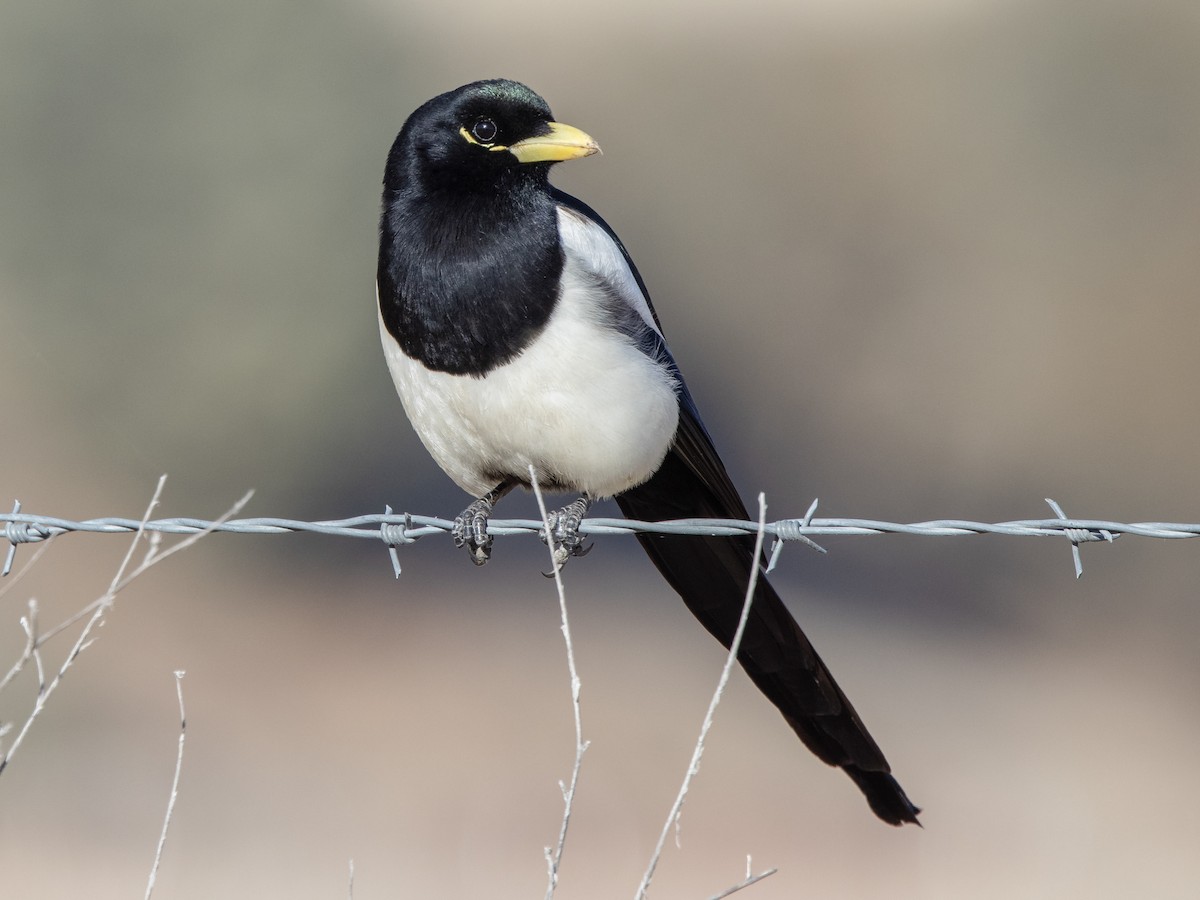
Habitat: Oak savannas, grassy areas, and scattered trees in California’s Central Valley and foothills.
Appearance: Black body with striking white belly and shoulders, iridescent green-blue sheen on wings and tail, and a bright yellow bill.
Key Characteristics:
- Beak Type: Thick and slightly curved, versatile for a varied diet.
- Feather Type: They are glossy and stiff
- Weight: 120-150 grams
- Size: 40–50 cm in length
- Wing Length: 55–60 cm
- Lifespan: 5–10+ years.
Feeding Habits: Omnivorous, seeds, insects, carrion, small mammals, and fruits. Highly social foragers.
Mating Habits: Monogamous pairs build large, domed nests high in trees.
Fun Facts: Extremely intelligent and playful, like other corvids. They are California’s only endemic magpie.
Note: This species is listed as Vulnerable due to habitat loss and West Nile virus impacts. Protecting oak woodlands helps their survival.
Excellent spots for these black bird with yellow beak include Coyote Valley (South San Jose/Morgan Hill), East Bay oak groves, and agricultural edges. Look for their noisy groups in spring and summer.
European Starling (Sturnus vulgaris)

Habitat: Highly adaptable; open fields, urban areas, farms. Native to Europe/Asia, introduced worldwide, including North America.
Appearance: Breeding adults are glossy black with purple/green iridescence and a bright yellow bill. Winter birds show white speckles.
Key Characteristics:
- Beak Type: Long, pointed, good for probing soil.
- Feather Type: Shiny with metallic texture
- Weight: 60–100 grams
- Size: 20–23 cm long
- Wing Length: 37–42 cm
- Lifespan: Up to 5 years.
Feeding Habits: Omnivorous — insects, seeds, fruits. Often forage in large flocks.
Mating Habits: Polygamous; males sing varied songs and build nests in cavities to attract multiple females.
Fun Facts: Masters of mimicry. The yellow beak black bird can imitate other birds and even human voices. Massive synchronized murmurations are spectacular.
Identification Tips: Distinguish from Blackbird: Shorter tail, speckled winter plumage, more aggressive urban behavior.
Hill Myna (Gracula religiosa)
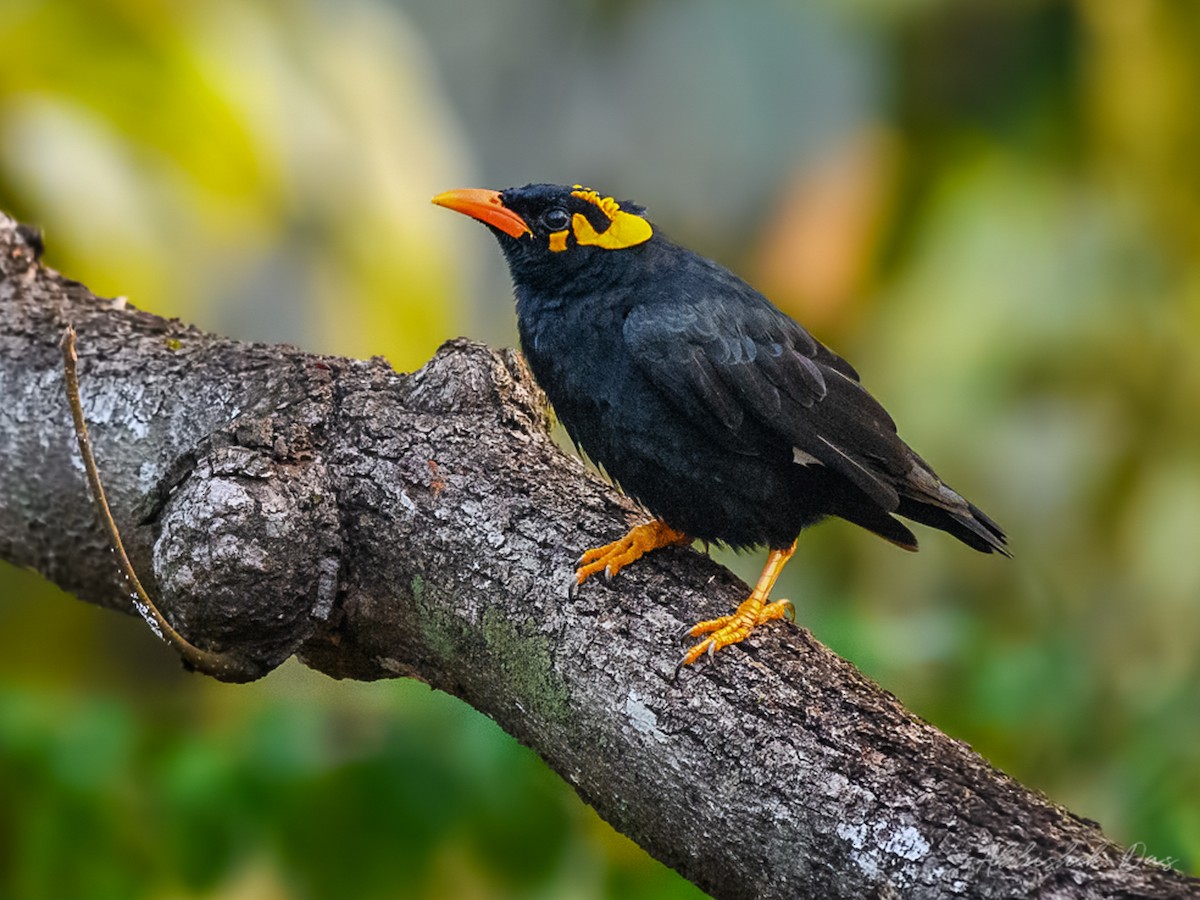
Habitat: Forests and farmlands of South and Southeast Asia.
Appearance: Glossy black with bright orange-yellow beak and yellow wattles (fleshy bumps) near the eyes.
Key Characteristics:
- Beak Type: Thick and curved.
- Feather Type: Shiny and fleshy
- Weight: 200–300 grams
- Size: 25–30 cm long
- Wing Span: 36–40 cm
- Lifespan: 12–25 years (long-lived for a passerine).
Feeding Habits: Frugivorous, eats fruits and nectars and insects.
Mating Habits: Monogamous. Nest in tree cavities.
Fun Facts: Exceptional vocal mimics, often kept as pets for their ability to copy human speech clearly.
Yellow-billed Chough (Alpine Chough, Pyrrhocorax graculus)
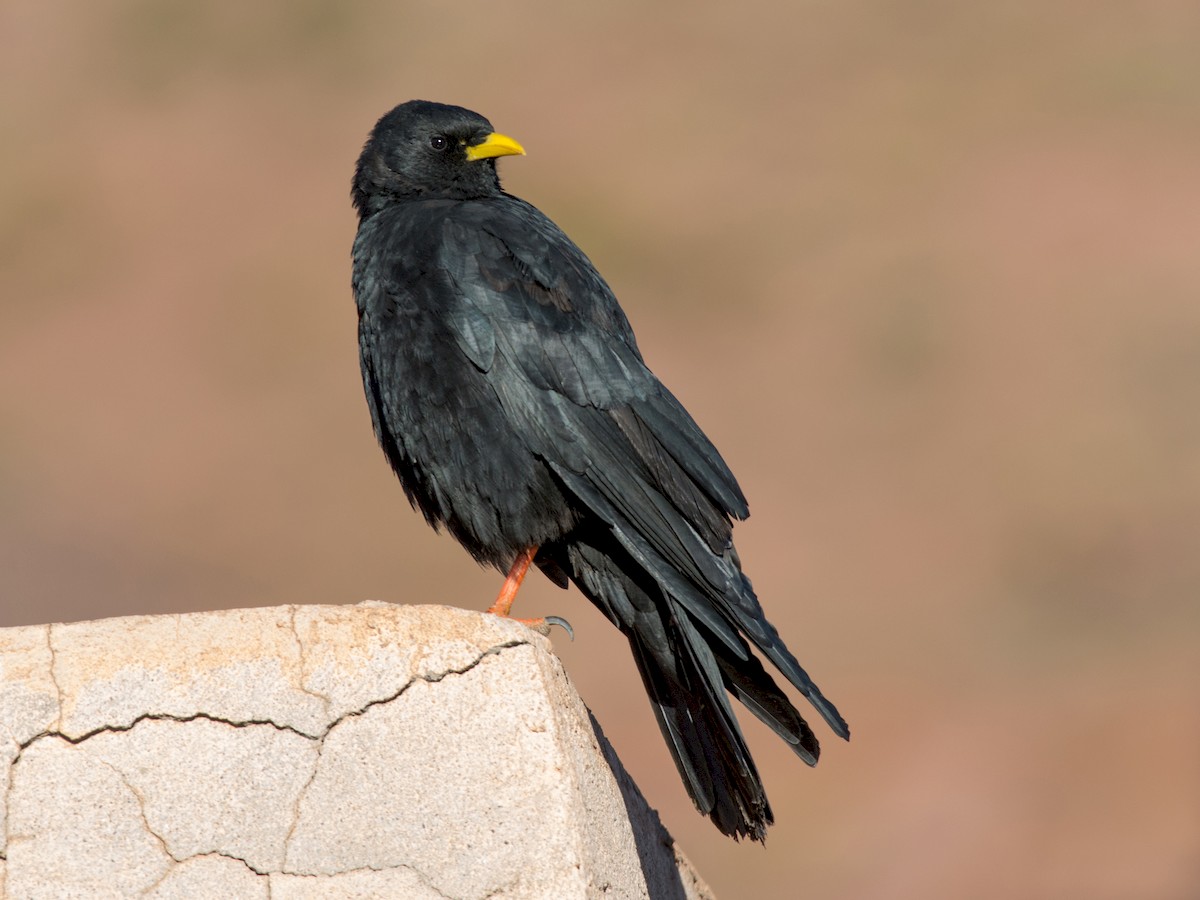
These two mountain specialists are often grouped due to similarities.
Habitat: High mountains, cliffs, and alpine meadows in Europe, North Africa, and Asia.
Appearance: The small black bird with yellow beak has glossy black plumage, a slender and bright yellow bill, and vivid red legs.
Key Characteristics:
- Beak Type: thin and slightly curved, to scour best
- Feather Type: They are soft and shiny
- Weight: 180–250 grams
- Size: 37- 39 cm in length
- Wing Length: 65 to 75 cm
- Lifespan: 10–20 years.
Feeding Habits: Insects, seeds, berries, and human scraps.
Mating Habits: Monogamous lifelong pairs with impressive aerial courtship displays.
Fun Facts: Acrobatic flyers performing loops and dives. Highly sociable.
This is the same species known by both names (an Old World bird with no natural distribution in North America). It is most easily confused with the Red-billed Chough, which has a longer, curved red bill.
Common Myna (Acridotheres tristis)

Habitat: Common in Asia, generally found in cities, farms, and open forests.
Appearance: Glossy black-brown with bright yellow bill and yellow eye patch.
Key Characteristics:
- Beak Type: Pointed and sturdy.
- Feather Type: Smooth and semi-glossy
- Weight: 100-150 grams. Size: 23–26 cm
- Wing Length: 40–50 cm
- Life Span: 12–15 years
Feeding Habits: Fruits, grains, insects.
Mating Habits: They make pair bonds and build nests in tree holes or human-made buildings.
Fun Facts: Excellent mimics of human voices and sounds.
Yellow-billed Cuckoo (Coccyzus americanus)
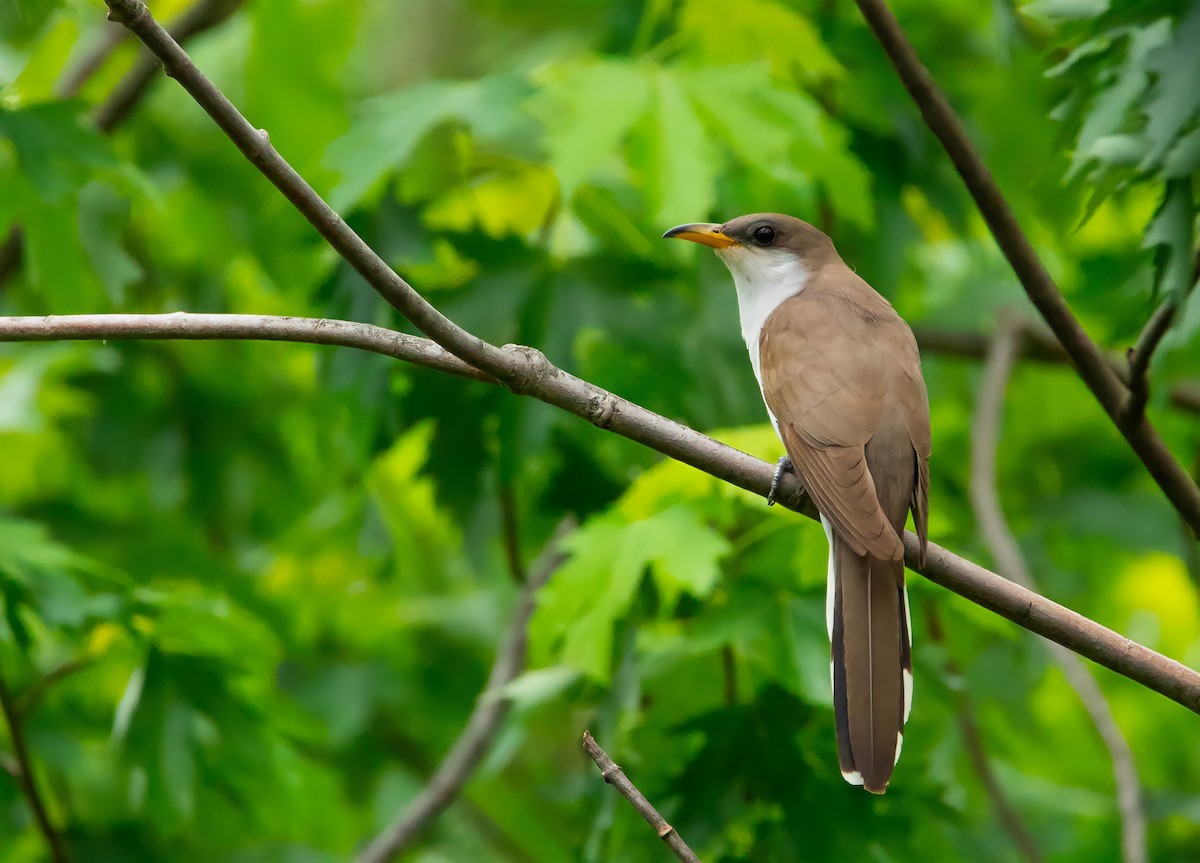
Habitat: They inhabit North and South America, surviving even in dense woods and forests.
Appearance: Brownish-black upperparts, long tail with white spots below, and a curved bill that is mostly yellow on the lower mandible.
Key Characteristics:
- Beak Type: Hollowed, slender, and curved
- Feather Type: Long and soft, thick
- Weight: 60–90g
- Size: 26–30cm long
- Wing Length: 38–43cm
- Life Span: 5–6 years
Feeding Habits: They are insect eaters and consume caterpillars, beetles, and small fruits.
Mating Habits: Brood parasitic in some cases (lay eggs in other birds’ nests).
Fun Facts: Nicknamed “rain crow”, because this blackbird with yellow beak call is said to predict rain.
More Species: Additional Black Birds with Yellow Beaks
Here are three more notable species that fit the “black bird with a yellow beak” theme but were not included in the main list:
Black Crake (Zapornia flavirostra)
Black Crake is a small, pudgy waterbird found in freshwater marshes, swamps, and reedbeds across sub-Saharan Africa. It has slate-black plumage with a subtle olive-brown tone on the wings, a bright yellow bill, vivid red eyes, and distinctive pink-red legs, creating a sharp and colorful contrast as it forages boldly along wetland edges for insects, small fish, frogs, and plant matter.

Black Thrush (Turdus infuscatus)
The Black Thrush inhabits humid evergreen and pine-oak forests in the highlands of Mexico and Central America at elevations of 900–3,100 meters. The adult male is strikingly all-black with a bright yellow bill, yellow eye-ring, and yellow legs, while the female is olive-brown; it feeds mainly on fruits and insects in the forest canopy, often joining mixed flocks with other thrushes.

Chinese Blackbird (Turdus mandarinus)
Chinese Blackbird is a large, sooty-black thrush commonly seen in open forests, gardens, farms, and urban parks across much of China and parts of Indochina. Males appear almost entirely black with an orange-yellow bill, while females are dark brown. It frequently forages on lawns and fields, pulling up worms and invertebrates, making it one of the more familiar dark thrushes in East Asia.

FAQs about Black Bird with Yellow Beak
How do you attract black birds with yellow beaks to your backyard?
Offer mealworms, suet, fruits, and provide nest boxes or dense shrubs. Keep water sources clean.
Are any of these birds protected?
Many are. The Yellow-billed Magpie is Vulnerable, avoid disturbing nests.
What’s the difference between Starling and Blackbird?
Starlings have shorter tails, speckles in winter, and more iridescence. Blackbirds have longer tails and melodic songs.
Conclusion
From the melodic songs of the Common Blackbird to the intelligence of the Yellow-billed Magpie and the mimicry skills of mynas and starlings, black birds with yellow beaks showcase nature’s diversity and adaptability. Knowing these birds empowers people to care for them, respect where they live, and realize how important this relationship is.
Share your sightings in the comments, and consider supporting local conservation efforts. Happy birding!

1 comment
A small blackbird with yellow beak n red eyes a Brewers blackbird


