



10 Birds with Big Beaks: Unique Species from Pelicans to Hornbills
Birds are among the most diverse groups of animals on Earth. Many bird species are highly adapted to their environments and ways of life. One of the most interesting features of birds is the beak. A bird’s beak is not just used for feeding; it can also reveal clues about behavior, diet, and ancestry. From the enormous pouch of a pelican to the casque-topped bill of a hornbill, large beaks show how birds have adapted to different ways of surviving.
This article explores ten bird species renowned for their impressively large beaks. It focuses on their beaks' shape, size, and function and explains their looks, homes, and activities. These species show how beak shape helps birds survive in different environments.
Toco Toucan
The Toco Toucan is a large South American bird known for its huge orange-yellow bill, which helps it reach fruit and regulate body temperature.

Habitat:
Toco Toucans are found across parts of South America, including Brazil, Paraguay, Bolivia, and northern Argentina. These birds are commonly observed in open woodlands and savannas, where they have simple access to several fruit-producing trees.
Appearance:
The Toco Toucan is a colorful bird with a vibrant orange-yellow beak and black, shiny, glossy feathers on the other parts of its body. It has a white throat, glossy black plumage, and blue skin around the eyes.
Characteristics:
- Beak Type: The Toco Toucan has a large but lightweight bill that can reach around 15 to 23 cm in length. Although it looks heavy, the bill is made of keratin and has a lightweight internal structure filled with air spaces.
- Plumage is mostly glossy black with a white throat and undertail coverts.
- Weight: Around 500 to 860 grams.
- Size: About 22 to 26 inches long.
- Wingspan: Around 43 to 50 inches.
- Life Span: The Toco Toucan can live between 16 and 20 years in the wild.
Feeding Habits:
Toucans are mainly frugivorous but feed on insects, eggs, and lizards.
Mating Habits:
Toco Toucans nest as monogamous breeding pairs and males and females exhibit playful courtship behavior by feeding each other fruits.
Fun Facts:
- Toco Toucans control their body temperature by changing the blood supply in their beaks.
- They use beaks to pull fruits off tree branches.
- Their large bills help them reach fruit on branches that may be too thin to support their weight.
Australian Pelican
This species has one of the longest bills of any bird. It uses its pouch to scoop up fish and water before draining the water away.

Habitat:
Australian Pelicans are found across Australia and also occur in New Guinea, parts of Indonesia, and New Zealand.
Appearance:
This pelican species has white plumage, black primaries, and a massive pale pink bill with a large throat pouch. The start of the beak, which has ridges and grooves on the mouth, is seen most clearly when the mouth is open to contain water or food.
Characteristics:
- Beak Type: Easily recognizable, it has one of the most extended beaks, measuring up to 19 inches long. Its long bill and pouch help it scoop fish from the water and hold them briefly before swallowing.
- Feather Type: In this species, the feathers of the Australian Pelicans are waterproof, making them float on water while also acting as an excellent insulating layer.
- Weight: Ranges between 4 and 6.8 kilograms.
- Size: About 1.6 to 1.8 meters long.
- Wingspan: These birds have a wing span of 2.2-2.6 meters.
- Life Span: They usually survive for about fifteen to twenty-five years.
Feeding Habits:
Australian Pelicans mainly feed on fish, which is caught using the pouch at the end of the beak.
Mating Habits:
During courtship, males may display by posturing, splashing, and moving their bills.
Fun Facts:
- The Australian Pelicans can pick up to 13 liters of water in their beaks.
- They can also hunt cooperatively, chasing fish into shallow water with others.
Shoebill Stork
It is a giant wetland bird native to East and Central Africa. It has a ‘shoe-like' beak and is used for grasping big fish.

Habitat:
Native to East Africa, you can find Shoebill Storks in swamps, marshes, and wetlands near freshwater sources. Their preferred habitat includes areas with dense vegetation and abundant fish.
Appearance:
This large, shoe-shaped beak characterizes it. Its body color is usually grey-blue. Due to its serious grimace and massive head, it remains an unforgettable sight.
Characteristics:
- Beak Type: The Shoebill is known for its huge, shoe-shaped bill, which is broad, deep, and hooked at the tip. And hooks at the point where the two halves of the upper mandible come together.
- Feather Type: Their feathers are thick and waterproof, which helps when dwelling in a region with many swamps.
- Weight: Its weights range from 4 to 7 kilograms.
- Size: It can be 1.6-1.8 meters long.
- Wingspan: It has a wingspan of about 2.3-2.5 meters.
- Life Span: In the wild, they live for about 35 years.
Feeding Habits:
Shoebills feed on lungfish, catfish, eels, frogs, and small reptiles, using their powerful bills to seize and handle large prey.
Mating Habits:
Shoebills are usually solitary and build large nests in remote wetlands with dense vegetation.
Fun Facts:
- Shoebills are famous for their inactivity for quite a long time while waiting for their prey to approach them.
- Their bills are strong enough to handle large, slippery prey such as lungfish.
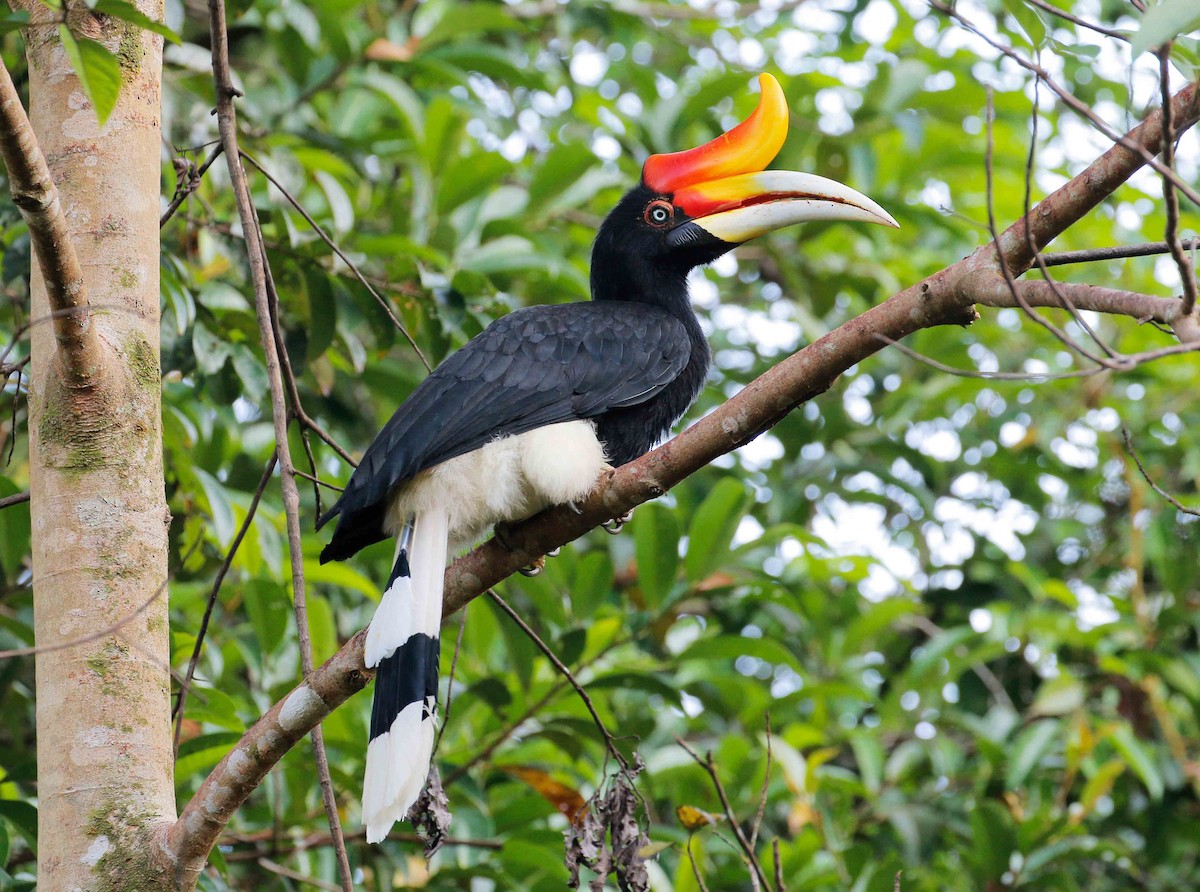
Rhinoceros Hornbill
This large Southeast Asian forest bird has a prominent casque above its curved bill for sounding and making long calls during courting.
Habitat:
Popularly known in the Southeast Asian rainforests, Rhinoceros Hornbills are found in countries such as Indonesia, Malaysia, and Thailand. They prefer to live in areas with heavy forest cover containing fig trees.
Appearance:
This bird's curved orange crest on its beak is easily distinguished from the rest of its black feathers and white tail.
Characteristics:
- Beak Type: The beak is long and dark-curved, with a bright-colored casque at the back. It plays a role in courtship displays, vocal resonance, and visual signaling.
- Feather Type: These include shiny-looking feathers that come in handy when moving around the forest canopy.
- Weight: Around 2 to 3 kilograms.
- Size: These birds are 43-47 inches long.
- Wingspan: These birds have an approximate wing span of 59-70 inches.
- Life Span: They live up to 35 years.
Feeding Habits:
Rhinoceros Hornbills feed mainly on fruits, especially figs, insects, and other forms of small animals.
Mating Habits:
It is a monogamous species; the female nests inside a tree cavity and depends on the male to bring food in which she lays and breeds and depends on the male for food supply.
Fun Facts:
- These are held sacred in some cultures and are associated with purity, especially for the female gender. They are also a symbol of loyalty.
- Their casque also boosts calls; hence, their cries are heard several kilometers away.
Black Skimmer
This seabird has an unusual bill in which the lower mandible is longer than the upper one. Thus, the bird takes fish from the water's surface with this unique tool.

Habitat:
Black Skimmers are coastal birds seen in the North and South American regions. They are found in shorelines of sand, estuaries, seashores, and lagoons.
Appearance:
They are black and white with red legs and a pronounced asymmetric beak, with a red portion at the bottom and a black contour at the top.
Characteristics:
- Beak Type: The lower jaw extends beyond the upper jaw so they can touch the water's surface when searching for fish.
- Feather Type: Their sleek plumage helps them fly efficiently low over the water.
- Weight: Around 200 to 400 grams.
- Size: They are 20 inches in size.
- Wingspan: Their wingspan is up to 44-50 inches.
- Life Span: They live about 20 years.
Feeding Habits:
These birds catch fish by flying low over the water with the lower bill slicing through the surface.
Mating Habits:
Breeding Black Skimmers are formally monogamous and are known to adopt a ground-nesting habit.
Fun Facts:
- They are the only bird species that feed like this when skimming low over the water's surface.
- Black Skimmers’ pupils can contract to become skinny, bar-like to minimize glare from water.
American White Pelican
A large and gregarious feeder with a long, saccate beak feeds on fish in shoals, sometimes cooperatively driving shoals of prey towards shallow water.

Habitat:
The American White Pelican breeds mainly in North America's freshwater lakes, marshes, and reservoirs. During winter, it moves to coastal lagoons and estuaries along the coasts of Central and South America.
Appearance:
These pelicans are beautiful in white, with black tips at the end of their wings and bright orange at the end of the bill. Their size and beautifully floating flight make it mouth-watering to watch them.
Characteristics:
- Beak Type: They have very long beaks, ranging from 7 to 14 inches long, which allows them to have compartments that catch and hold fish.
- Feather Type: Their plumage is water-resistant and helps them stay buoyant.
- Weight: They range from 5 to 9 kilograms.
- Size: Their size is about 50-70 inches long.
- Wingspan: These birds have a wingspan of 95-120 inches.
- Life Span: They typically live about 16 to 25 years in the wild.
Feeding Habits:
These birds can actively coordinate a large group and trap fish in shallow waters with their beak.
Mating Habits:
Males and females perform synchronized courtship displays, and pairs remain together for the breeding season.
Fun Facts:
- Unlike Brown Pelicans, American White Pelicans usually feed by swimming and scooping fish from the water.
- During the breeding season, they develop a temporary horn-like plate on the upper bill.
Southern Ground Hornbill
It is a ground-dwelling savanna bird with a powerful curved beak used for digging, hunting, and handling prey.

Habitat:
Southern Ground Hornbills live in savannas, grassland, and open wooded areas in the sub-Saharan region. They prefer areas with sparse vegetation to facilitate ground foraging.
Appearance:
It has a black plumage with a bright red face and hindneck, with a large dark bill that may show paler tones near the base. With a long, curved beak to blade, their bill is substantial, significant, and proportional to the bird’s impressive stature.
Characteristics:
- Beak Type: Their beaks are large, strong, and curved, and they can dig and hunt small animals.
- Feather Type: Its dark plumage helps it blend into open woodland and grassland habitats.
- Weight: They usually weigh around 3 to 6 kilograms.
- Size: Their size is 4 ft 3 inches.
- Wingspan: They have a wingspread of Up to 5 ft 11 in.
- Life Span: These birds may live as long as fifty years, probably one of the longest-lived birds in the world.
Feeding Habits:
These are carnivorous since they capture and devour small insects, rodents, and even reptiles.
Mating Habits:
Hornbills are monogamous birds, and during courtship, the male offers the female a titbit.
Fun Facts:
- They play a crucial role in folklore and are considered patrons of rain and fertility.
- These hornbills feed on hard-shelled animals such as tortoises and use their beaks to open them.
Great Hornbill
The Great Hornbill is a colorful tropical bird with a large curved bill and casque, which it uses in display behavior and when handling fruit.

Habitat:
Hornbills are tropical birds found in the South and Southeast Asian regions, including India, Bhutan, and Indonesia. They prefer tall, dense tropical forests, often in tall, dense tropical forests.
Appearance:
The Great Hornbill is an iconic bird with a massive yellow casque atop its beak. It is also characterized by black-and-white colors, wings, claws, and impressively long tail coverts.
Characteristics:
- Beak Type: The beak is thus curved, strong, and balanced by the casque, employed in the displays of courtship and territoriality.
- Feather Type: Their plumage helps them blend into the forest canopy, especially when viewed from a distance.
- Weight: They weigh between 2.5 and 4 kilograms.
- Size: The Great Hornbill has a size of 37.4-47.24 inches.
- Wingspan: An adult Great Hornbill has a wingspan of 59-70 inches.
- Life Span: In the wild, its life span is scientifically estimated to be between 30 and 40 years.
Feeding Habits:
These are frugivorous birds that feed mainly on fruits, though they also eat insects and small animals from time to time and other small animals.
Mating Habits:
The female seals itself in a tree hole during mating, only opening up a chink through which the male brings in food.
Fun Facts:
- They are vital seed dispersers for tropical forests, aiding in forest regeneration.
- Their calls can be heard up to one kilometer away, and their calls can carry long distances through the forest.
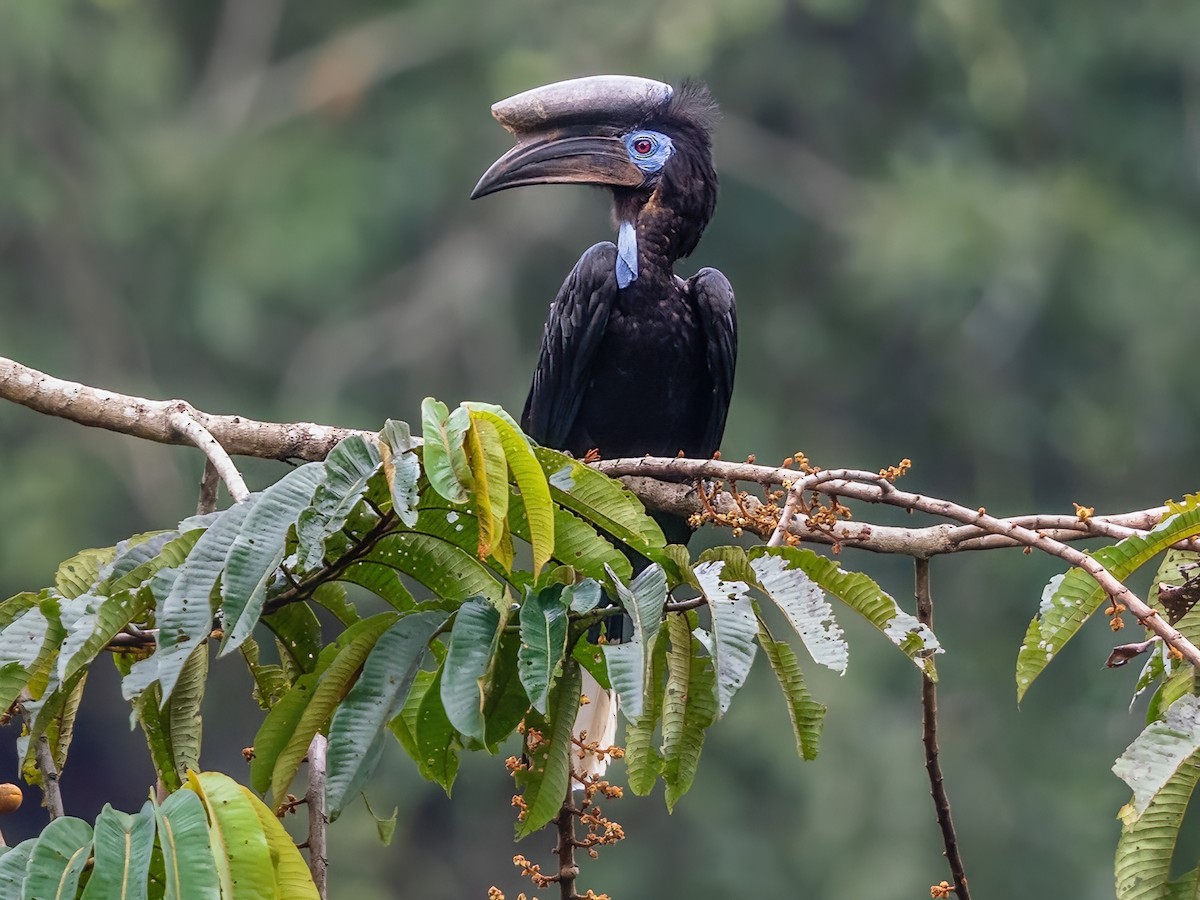
Black-Casqued Hornbill
It is endemic to the African rainforest and features a prominent casque and robust, sharp beak that opens fruits and amplifies calls.
Habitat:
The Black-Casqued Hornbill is a bird that lives in the tropical rainforests of central and western Africa, including countries such as Gabon and Cameroon. It is suggested that it prefers thickly wooded areas with a plentiful supply of fruiting trees.
Appearance:
This hornbill has dark plumage, a large casque, and a long tail, but has a black color, a white-with-an-ivory look on the casque, and long tail feathers. Its highly developed beak adds to its giant size in general.
Characteristics:
- Beak Type: Its large bill is used for handling fruit, foraging, and display-related interactions.
- Feather Type: The birds are glossy black, which helps them camouflage easily in the forest region.
- Weight: These hornbills weigh between 2.5 and 3.5 kilograms.
- Size: Their size is 70 cm.
- Wingspan: They have broad wings suited to movement through forested habitats.
- Life Span: They live about 30 years in the wild.
Feeding Habits:
Some species feed on fruits, while those that cannot get fruits feed on small animals and insects.
Mating Habits:
As in other species of hornbills, the female is enclosed in a tree hole during incubation and mainly depends on the male for feeding.
Fun Facts:
- Their casque may help amplify calls, acting as a resonance chamber.
- A group of Black-Casqued Hornbills is commonly sighted in small flocks.
Marabou Stork
A large scavenger with a heavy densely long pointed beak, which is suitable for ripping off carcasses and facilitating the cleaning of landscapes in Africa’s savannas and wetlands.

Habitat:
Marabou Storks live across sub-Saharan Africa in wetlands, floodplains, savannas, and near human settlements.
Appearance:
These are large, bald birds with dark grey plumage and a huge bill. The skin hanging at the bird’s throat is flabby and hangs low.
Characteristics:
- Beak Type: Their large, sharply pointed bill is perfect for sorting and tearing the carrion initially.
- Feather Type: They have few coarse feathers, contributing to their adaptation to hot environments.
- Weight: They typically weigh between 4 and 8 kilograms.
- Size: The size of these birds is 54-60 inches.
- Wingspan: Marabou Storks have a wingspan of up to 156 inches.
- Life Span: These storks can live for around 25 years in the wild.
Feeding Habits:
It feeds on carrion, besides small mammals, and can even feed on garbage.
Mating Habits:
In breeding season, males perform display behaviors that may include bill clattering.
Fun Facts:
- Marabou Storks are often called “undertaker birds” because of their appearance.
- As scavengers, they are instrumental in ecosystems since they feed on carcasses, cleaning the environment.
Want a Closer Look at Bird Beaks?
If you enjoy noticing details like beak shape, feeding style, and bird behavior, a smart bird feeder can make backyard birdwatching even more rewarding. A camera feeder like Birdfy lets you observe visiting birds up close, which makes it easier to notice small field marks that are often missed from a distance.
While many of the birds in this list are not typical feeder visitors, using a feeder camera is still a great way to learn how different beak shapes reflect different diets and behaviors in the birds around your own home.

Birdfy Feeder 1
Experience crystal-clear 2K resolution. Every detail brought right before your eyes.
Buy NowConclusion
Birds with the biggest beaks are some of the most interesting species. Each species shows how beak size and shape are closely tied to feeding style, habitat, and survival, such as fishing, opening fruits, or gathering carcasses. Their unique characteristics, behaviors, and appearances reflect nature's incredible diversity and resilience. The knowledge about these fascinating birds helps improve the understanding of bird life and promotes the cause of protecting their habitats and ensuring their existence.
15% OFF
Storewide Exclusives
Enter the code at checkout to enjoy the discount.
Share


