



30 Birds With Red Heads: Photos and Identification Tips
Birds with red heads are some of the easiest species to notice in the field, but they are not always easy to identify. Some have a fully red head, while others show only a red cap, crest, face, forehead, or nape.
In this guide, you’ll find 30 birds with red heads or other obvious red head markings, along with quick identification features, habitat notes, and where each species is found.
If you saw a bird with a red head and want to figure out what it was, start by looking at how much of the head is red, the bird’s body color, its bill shape, size, and location. Those details usually narrow the options quickly.
How to Identify a Bird With a Red Head
When trying to identify a red-headed bird, focus on these details:
- How much of the head is red: full head, cap, face, forehead, or crest.
- Body color: black, gray, brown, yellow, or white body tones can narrow the options quickly.
- Bill shape: thick finch bills, pointed woodpecker bills, and hooked parrot bills all suggest different groups.
- Size: some red-headed birds are tiny feeder birds, while others are large forest species.
- Location and habitat: a backyard finch in North America is very different from a tropical tanager or African weaver.
Woodpeckers With Red Heads
Red-headed Woodpecker
- Scientific name: Melanerpes erythrocephalus
- Where found: North America
- Size: Medium
The Red-headed Woodpecker is one of the most unmistakable birds with a red head. Adults have a fully crimson head, a glossy black back, and bold white wing patches that stand out both at rest and in flight.

- Red marking: Entire head
- How to identify: Bright red head, black back, white belly, bold white wing panels
- Habitat: Open woodlands, groves, dead-tree areas, parks
- Often confused with: Red-bellied Woodpecker
- Field tip: If the whole head is solid red, it is much more likely to be a Red-headed Woodpecker than a Red-bellied Woodpecker.
Red-bellied Woodpecker
- Scientific name: Melanerpes carolinus
- Where found: Eastern United States
- Size: Medium
Despite its name, the Red-bellied Woodpecker is usually identified by the red on its head rather than its belly. Males show red from the crown to the nape, while females usually show red on the nape and a smaller patch on the forehead.

- Red marking: Crown and nape
- How to identify: Black-and-white barred back, pale face, long bill
- Habitat: Woodlands, suburbs, orchards, mature trees
- Often confused with: Red-headed Woodpecker
- Field tip: This bird does not have a fully red head. Look for the zebra-like barred back.
Acorn Woodpecker
- Scientific name: Melanerpes formicivorus
- Where found: Western North America, Central America
- Size: Medium
The Acorn Woodpecker is a social species with a red crown and a sharply patterned black-and-white face. It is especially well known for storing acorns in granary trees.

- Red marking: Crown
- How to identify: Red cap, white forehead, pale eye, clown-like face
- Habitat: Oak woodlands, pine-oak forests
- Often confused with: Red-headed Woodpecker
- Field tip: The face pattern is the easiest clue. It looks very different from the smoother color blocks of a Red-headed Woodpecker.
Acorn Woodpeckers are highly social birds and are often found in family groups or small colonies. They are noisy and gregarious, with a variety of calls and vocalizations used for communication within the group.
Pileated Woodpecker
- Scientific name: Dryocopus pileatus
- Where found: North America
- Size: Large
With its vibrant red crest, bold black and white plumage, and long neck, the Pileated Woodpecker is a sight to behold. Adult males and females are similar in appearance, although males may have slightly larger crests. Their powerful bill is used to excavate cavities in trees for nesting and foraging.

- Red marking: Crest
- How to identify: Large black body, long neck, red crest, white facial stripes
- Habitat: Mature forests, wooded swamps, large parks
- Often confused with: Ivory-billed Woodpecker in old reports, but that species is functionally absent
- Field tip: If the bird looks crow-sized with a flame-like crest, it is likely a Pileated Woodpecker.
This woodpecker species is known for its distinctive drumming, a series of rapid, loud knocks on dead trees or other resonant surfaces. The drumming serves as a means of communication between individuals and as a territorial display.
Yellow-bellied Sapsucker
- Scientific name: Sphyrapicus varius
- Where found: North America
- Size: Medium
This migratory woodpecker has a red forehead, and males also show a red throat. It is known for drilling neat rows of sap wells in trees.

- Red marking: Forehead; male also has red throat
- How to identify: Black-and-white body, white wing stripe, pale yellow wash below
- Habitat: Forests, mixed woods, migration stopovers
- Often confused with: Red-naped Sapsucker
- Field tip: Look for clean white wing patches and orderly sap wells in nearby trees.
Red-naped Sapsucker
- Scientific name: Sphyrapicus nuchalis
- Where found: Western North America
- Size: Medium
This species is similar to the Yellow-bellied Sapsucker but has a distinct red patch on the nape.

- Red marking: Crown and nape
- How to identify: Red throat, white wing stripe, barred back, red nape patch
- Habitat: Aspen groves, conifer forests, mountain woods
- Often confused with: Yellow-bellied Sapsucker
- Field tip: The red nape is the best clue if you get a clear side view.
Williamson’s Sapsucker
- Scientific name: Sphyrapicus thyroideus
- Where found: Western North America
- Size: Medium
This species is unusual because the sexes look very different. Males are black with bright white markings and a red throat patch.

- Red marking: Male throat; some red on head area can be noticed depending on angle
- How to identify: Black body, white wing patches, yellow belly, red throat in males
- Habitat: Mountain conifer forests
- Often confused with: Other sapsuckers
- Field tip: The male’s bold contrast makes it easier to identify than the female.
Small Red-Headed Birds at Feeders and Shrubby Areas
House Finch
- Scientific name: Haemorhous mexicanus
- Where found: North America
- Size: Small
The House Finch is one of the most common answers to the question, “What small bird has a red head?” Males usually show red on the forehead, face, throat, and upper chest.
House Finches are small, colorful birds with males displaying bright red plumage on their heads, throats, and chests, while females have more subdued brown and streaked plumage.

- Red marking: Face, forehead, throat
- How to identify: Brown streaked body, red face, thick finch bill
- Habitat: Towns, suburbs, gardens, open country
- Often confused with: Purple Finch
- Field tip: House Finches usually look more streaked below than Purple Finches.
House Finches form monogamous pairs during the breeding season, and both parents participate in building the nest, incubating the eggs, and feeding the young. They are known for their adaptability to human-modified landscapes, often nesting in buildings, eaves, and hanging planters.
Purple Finch
- Scientific name: Haemorhous purpureus
- Where found: North America
- Size: Small
The Purple Finch is a small finch found in forests and at feeders in North America. Males are often identified by the rich raspberry-red wash over the head and chest.
Females, while less colorful, still display a subtle streaked pattern of brown and white, making them easily distinguishable from other bird species.

- Red marking: Head, face, and breast
- How to identify: Stronger red wash, less sharply streaked body, chunky finch shape
- Habitat: Conifer forests, mixed woods, feeders in winter
- Often confused with: House Finch
- Field tip: Birders often say a Purple Finch looks like a sparrow dipped in raspberry juice.
Common Redpoll
- Scientific name: Acanthis flammea
- Where found: Northern North America and Eurasia
- Size: Small
The Common Redpoll is a tiny finch with a neat red cap and black chin. In winter, flocks may visit feeders farther south than usual.
These small finches are renowned for their distinctive red caps and black chins, as well as their streaked brown and white plumage, which provides excellent camouflage in their snowy habitats.

- Red marking: Forehead cap
- How to identify: Small size, striped body, black chin, red cap
- Habitat: Boreal regions, scrub, winter feeders
- Often confused with: Hoary Redpoll
- Field tip: The red area is small, more like a cap than a full red head.
Red Crossbill
- Scientific name: Loxia curvirostra
- Where found: North America, Europe, Asia
- Size: Medium
The Red Crossbill does not have a fully red head, but males often show reddish tones on the head and body. Its crossed bill is the most important feature to look for.

- Red marking: Often reddish head and body in males
- How to identify: Crossed bill, finch shape, conifer habitat
- Habitat: Pine, spruce, fir forests
- Often confused with: White-winged Crossbill
- Field tip: If the bill tips cross over each other, that feature is more important than the exact shade of red.
Pine Grosbeak
- Scientific name: Pinicola enucleator
- Where found: Northern North America and Eurasia
- Size: Large finch
Male Pine Grosbeaks display striking colors, with a rosy-pink plumage that intensifies in the breeding season, while females and juveniles have more subdued brown and gray plumage with streaks of yellow.
These large finches are named for their robust bills and their fondness for pine cones, which they use their powerful beaks to pry open and extract seeds.

- Red marking: Rosy head and upperparts in males
- How to identify: Thick bill, bulky shape, gentle expression
- Habitat: Boreal forest, mountain conifers
- Often confused with: Large finches and crossbills
- Field tip: The overall impression is soft and heavy-bodied, not sharp and streaky like many smaller finches.
Cardinals and Cardinal-Like Birds
Northern Cardinal
- Scientific name: Cardinalis cardinalis
- Where found: North America
- Size: Medium
The Northern Cardinal is one of the best-known red-headed birds in North America. Males are bright red overall with a pointed crest and black face mask, while females are tan-brown with reddish accents.

- Red marking: Full head and crest in males
- How to identify: Crest, thick orange bill, black mask
- Habitat: Backyards, woodland edges, thickets
- Often confused with: Pyrrhuloxia
- Field tip: In the eastern U.S., this is one of the most likely backyard birds with a red head.
Pyrrhuloxia
- Scientific name: Cardinalis sinuatus
- Where found: Southwestern United States and Mexico
- Size: Medium
The Pyrrhuloxia looks like a desert cousin of the Northern Cardinal. It is mostly gray, with red in the crest, face, chest, and wings.

- Red marking: Crest and face
- How to identify: Curved yellow bill, cardinal-like crest, gray body
- Habitat: Dry scrub, desert brush, thorny thickets
- Often confused with: Northern Cardinal
- Field tip: The yellow bill is a quick way to separate it from a Northern Cardinal.
Red-crested Cardinal
- Scientific name: Paroaria coronata
- Where found: South America
- Size: Medium
These medium-sized songbirds are named for the vibrant red crest that adorns their heads, contrasting beautifully with their white bodies and black masks. Their elegant appearance and delightful songs make them a treasured sight among birdwatchers and nature enthusiasts.

- Red marking: Crest and head
- How to identify: Red crest, black facial marking, white underparts
- Habitat: Open country, parks, gardens, scrub
- Often confused with: Red-capped Cardinal
- Field tip: The crest gives it a more dramatic shape than the smoother-headed Red-capped Cardinal.
Red-crested Cardinals inhabit a variety of habitats, including open woodlands, savannas, grasslands, and urban areas, where they forage for seeds, fruits, insects, and small invertebrates. They are often seen perched on exposed branches or hopping along the ground in search of food.
Red-capped Cardinal
- Scientific name: Paroaria gularis
- Where found: South America
- Size: Medium
The Red-capped Cardinal has a cleaner red cap and head pattern with a bold black throat patch and white body.

- Red marking: Cap and head
- How to identify: Red head, black throat, white body
- Habitat: Wetlands, river edges, open brush
- Often confused with: Red-crested Cardinal
- Field tip: It looks sleeker and less crested than the Red-crested Cardinal.
Tanagers and Other Red-Headed Songbirds
Summer Tanager
- Scientific name: Piranga rubra
- Where found: North and Central America
- Size: Medium
Male Summer Tanagers are rosy red all over, including the head. Although they are not red-headed in the narrowest sense, they are often searched by people trying to identify a solid red songbird.

- Red marking: Full head and body in males
- How to identify: Plain red body, thick pale bill, no black wings
- Habitat: Open woodlands, riparian woods, groves
- Often confused with: Scarlet Tanager
- Field tip: If the bird is fully red without black wings, think Summer Tanager.
Scarlet Tanager
- Scientific name: Piranga olivacea
- Where found: Eastern North America
- Size: Medium
These medium-sized songbirds are named for the vibrant scarlet-red plumage of breeding males, which contrasts strikingly with their black wings and tails. Females and immature individuals, however, display a more subdued olive-green hue, providing excellent camouflage in their forested habitats.

- Red marking: Full head and body in breeding males
- How to identify: Scarlet body, black wings, forest canopy behavior
- Habitat: Deciduous forests, mixed woodlands
- Often confused with: Summer Tanager
- Field tip: Black wings usually point to Scarlet Tanager.
Male Scarlet Tanagers sing melodious songs to establish territories and attract mates. They build cup-shaped nests in trees or shrubs, where females lay their eggs and both parents share incubation and feeding duties.
Western Tanager
- Scientific name: Piranga ludoviciana
- Where found: Western North America
- Size: Medium
The Western Tanager is not fully red-headed, contrasting with black wings and backs, and bold white wing bars. Breeding males display a distinctive red face, making them easily recognizable in their forested habitats.
Females and immature individuals, while less colorful, still exhibit lovely yellow hues on their bodies and wings.

- Red marking: Face
- How to identify: Yellow body, black wings, red face
- Habitat: Conifer and mixed forests
- Often confused with: Other tanagers
- Field tip: A yellow body plus red face is the key combination.
Western Tanagers inhabit a variety of forested habitats, including coniferous and mixed forests, as well as mountainous regions, where they forage for insects, spiders, and fruits.
Hepatic Tanager
- Scientific name: Piranga flava
- Where found: Southwestern U.S. to Central and South America
- Size: Medium
The Hepatic Tanager has a softer brick-red or rusty head and body in males, making it subtler than more vivid tanagers.
While they may not display the vibrant colors of some other Piranga species, their subtle beauty and cheerful songs make them a delight to observe in their natural habitats.

- Red marking: Head and body
- How to identify: Duller red tones, plain face, thick bill
- Habitat: Pine-oak woodlands, mountain forests
- Often confused with: Summer Tanager
- Field tip: It usually looks more muted and earthy than a Summer Tanager.
Vermilion Flycatcher
- Scientific name: Pyrocephalus rubinus
- Where found: Americas
- Size: Small
The male Vermilion Flycatcher is one of the most dazzling small red birds in the Americas. Its vivid red head and underparts contrast with dark brown upperparts.

- Red marking: Head, throat, and underparts in males
- How to identify: Small flycatcher shape, upright perch, bright red below
- Habitat: Open country, scrub, grasslands, riparian edges
- Often confused with: Other flycatchers, though few are this bright
- Field tip: Watch for a small bird sallying out from a perch to catch insects.
Red-faced Warbler
- Scientific name: Cardellina rubrifrons
- Where found: Southwestern United States and Mexico
- Size: Small
This striking warbler has a vivid red face framed by gray upperparts and white underparts.

- Red marking: Face
- How to identify: Red face, gray back, active warbler behavior
- Habitat: Pine-oak mountains, higher elevations
- Often confused with: Few other warblers in the same range
- Field tip: It is a specialty bird of mountain forests rather than backyard feeders.
Red-Headed Birds Around the World
Red-headed Finch
- Scientific name: Amadina erythrocephala
- Where found: Southern Africa
- Size: Small
This African finch has a bright red head that contrasts with a more subdued brown body.

- Red marking: Full head
- How to identify: Compact finch body, red face and head, pale underparts
- Habitat: Savannas, scrub, dry grasslands
- Often confused with: Other small African finches
- Field tip: The sharp contrast between the head and body is one of its best marks.
Red-headed Weaver
- Scientific name: Anaplectes rubriceps
- Where found: Sub-Saharan Africa
- Size: Small to medium
The male Red-headed Weaver stands out with its bright red head and contrasting darker body.

- Red marking: Head
- How to identify: Weaver shape, conical bill, bright head in breeding males
- Habitat: Open woodland, grassland, farmland
- Often confused with: Other African weavers
- Field tip: Breeding males are far more striking than nonbreeding birds.
Red-headed Barbet
- Scientific name: Eubucco bourcierii
- Where found: Central and South America
- Size: Small to medium
This colorful barbet shows a bright red head combined with green body tones, making it especially eye-catching in cloud forests.

- Red marking: Head
- How to identify: Chunky barbet shape, thick bill, bright green and red contrast
- Habitat: Cloud forests, humid montane forests
- Often confused with: Other tropical barbets
- Field tip: The stout bill and compact shape separate it from tanagers and finches.
Red-headed Manakin
- Scientific name: Ceratopipra rubrocapilla
- Where found: Central and South America
- Size: Small
Male Red-headed Manakins are glossy black with a brilliant red head, creating a dramatic contrast.
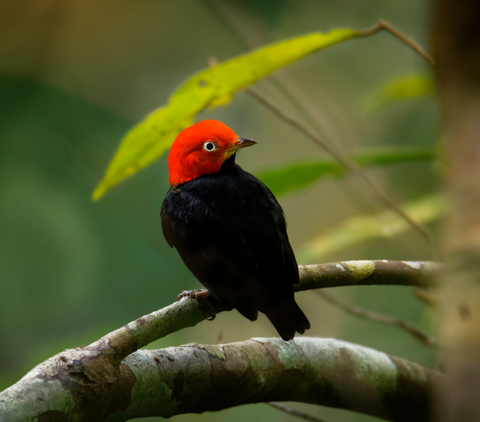
- Red marking: Head
- How to identify: Small body, black plumage, red cap-like head
- Habitat: Tropical forest understory
- Often confused with: Other manakins
- Field tip: Males often gather at display areas called leks.
Scarlet-headed Blackbird
- Scientific name: Amblyramphus holosericeus
- Where found: South America
- Size: Medium
This marsh bird is striking, with a scarlet head and black body.

- Red marking: Full head
- How to identify: Wetland habitat, long body, red head, black wings
- Habitat: Marshes, swamps, flooded grasslands
- Often confused with: Few other marsh birds with the same pattern
- Field tip: Habitat is one of the easiest clues here.
Red-crowned Parakeet
- Scientific name: Cyanoramphus novaezelandiae
- Where found: New Zealand
- Size: Small to medium
Also known as the Red-fronted or Red-crowned Parakeet depending on naming usage, this green parakeet shows a bright red crown and forehead.

- Red marking: Crown and forehead
- How to identify: Green body, red forehead, parakeet shape, long tail
- Habitat: Forests, scrub, islands, woodland edges
- Often confused with: Yellow-crowned Parakeet
- Field tip: The red on the forehead is clear, but the bird is mostly green overall.
Crimson Rosella
- Scientific name: Platycercus elegans
- Where found: Australia
- Size: Medium
The Crimson Rosella is mostly red rather than simply red-headed, but its bright red head and upper body make it a common inclusion in broad searches about red-headed birds.

- Red marking: Head and most of body
- How to identify: Crimson body, blue cheeks, broad tail
- Habitat: Forests, woodlands, gardens
- Often confused with: Other rosellas
- Field tip: The parrot shape and blue cheeks help immediately.
Red Avadavat
- Scientific name: Amandava amandava
- Where found: South and Southeast Asia
- Size: Small
Also called the Strawberry Finch, the breeding male Red Avadavat has rich red coloration on the head and body with white spotting.

- Red marking: Head and body in breeding males
- How to identify: Tiny finch, red plumage, white spots, short bill
- Habitat: Grasslands, wetlands, cultivated fields
- Often confused with: Other small finches
- Field tip: Outside breeding season, males and females look much duller.
Common Red-Headed Birds People Confuse
| Comparison | Key Differences | Best Clue |
|---|---|---|
| Red-headed Woodpecker vs. Red-bellied Woodpecker |
Red-headed Woodpecker: entire head is red Red-bellied Woodpecker: red is mostly on crown and nape |
Red-headed Woodpecker has large white wing patches and cleaner color blocks |
| House Finch vs. Purple Finch |
House Finch: streakier underparts, more limited red on face and chest Purple Finch: richer raspberry wash over much of the head and breast |
Purple Finch often looks more solidly colored |
| Northern Cardinal vs. Pyrrhuloxia |
Northern Cardinal: bright red male, orange-red bill Pyrrhuloxia: gray body, red highlights, yellow curved bill |
The bill color and shape separate them quickly |
| Yellow-bellied Sapsucker vs. Red-naped Sapsucker |
Yellow-bellied Sapsucker: no clear red nape patch Red-naped Sapsucker: distinct red patch on the nape |
Side view of the neck and head |
Want a Better Look at Red-Headed Birds?
If you enjoy spotting birds with red heads in your backyard, a camera bird feeder can make identification much easier. Birdfy helps you watch visiting birds up close and review clear footage later, which is especially useful when you are trying to tell apart similar species such as a House Finch and Purple Finch or a Red-headed Woodpecker and Red-bellied Woodpecker.

Birdfy Feeder 1
Experience crystal-clear 2K resolution. Every detail brought right before your eyes.
Buy NowFor bird lovers who want to learn more about field marks, behavior, and feeder visitors, it can be a simple way to make everyday birdwatching more rewarding.
FAQs about Red Headed Birds
What bird has a bright red head?
In North America, the Red-headed Woodpecker is one of the clearest examples of a bird with a bright red head. Outside North America, birds such as the Red-headed Finch or Scarlet-headed Blackbird may also fit that description.
What small bird has a red cap on its head?
A Common Redpoll is a classic small bird with a red cap. In backyards, a male House Finch may also appear to have a reddish head depending on the angle and lighting.
Is a Red-headed Woodpecker rare?
It is not the rarest woodpecker, but it is less common than some backyard species and has declined in parts of its range. Local abundance varies by habitat and region.
What is the difference between a House Finch and a Purple Finch?
House Finches are usually more streaked below and show more limited red on the head and chest. Purple Finches appear richer, fuller, and more evenly washed with raspberry-red.
Final Thoughts
Red-headed birds range from tiny feeder finches to large forest woodpeckers and brilliant tropical songbirds. Some have a fully red head, while others only show a red cap, face, or crest.
If you are trying to identify one, focus first on how much of the head is red, the bird’s body color, bill shape, size, and location. That combination will usually narrow the possibilities quickly.
15% OFF
Storewide Exclusives
Enter the code at checkout to enjoy the discount.
Share
2 comments
PERFECT! PERFECT! PERFECT!
Thank You!
PERFECT! PERFECT! PERFECT!
Thank You!


